
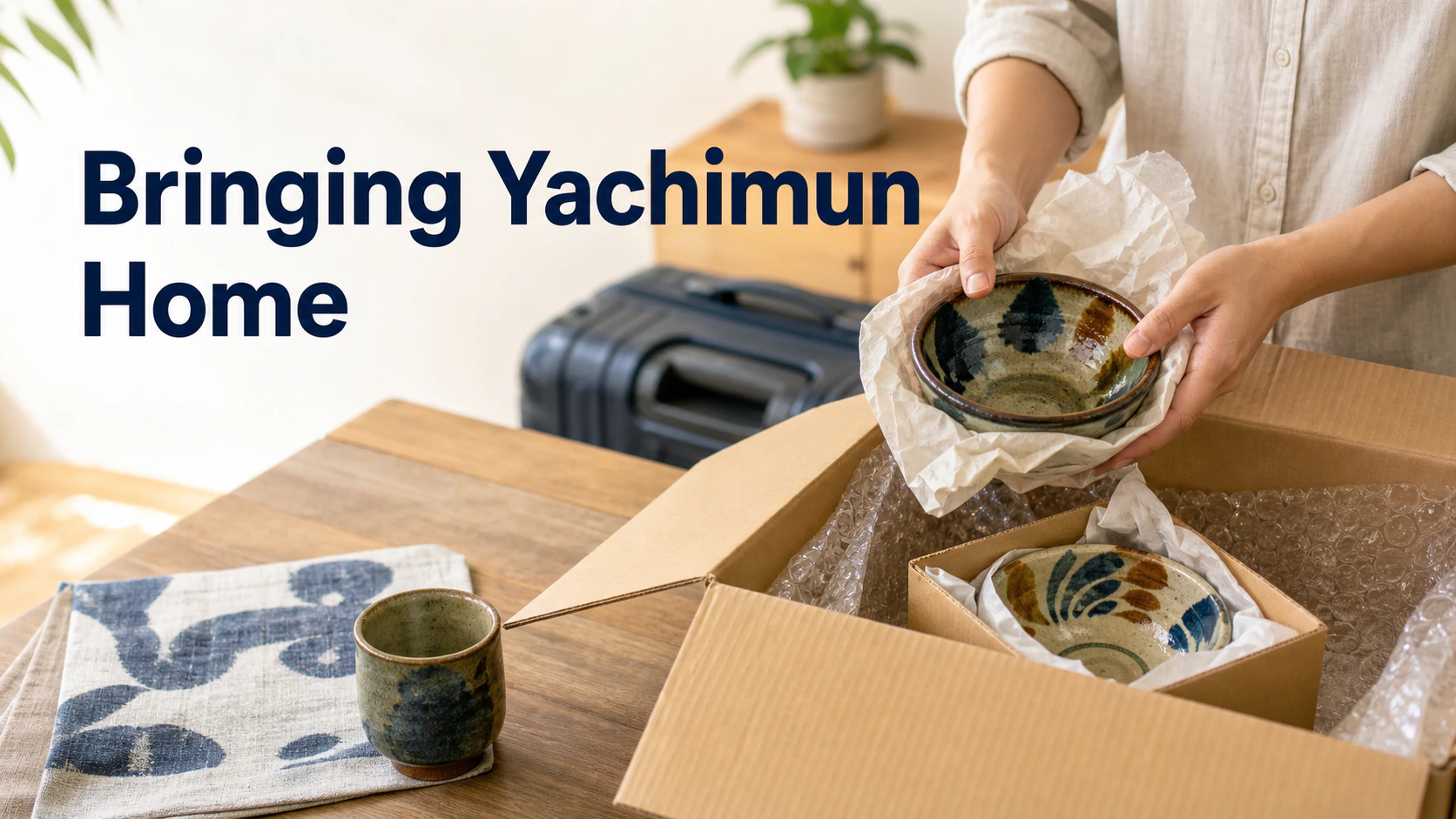
You found a piece of yachimun in Okinawa and want to use it at home. After buying it, however, many travelers are unsure whether it can go in their carry-on, whether the shop can ship it overseas, or whether they may mail a tax-free purchase themselves. Pottery is heavy and vulnerable to impact, while airline, postal, customs, and tax-free rules operate separately. That is why the entire journey from purchase to arrival home needs to be planned as one process.
Regional comparisons and advice on choosing individual pieces are covered separately. This guide focuses on the practical steps after purchase for taking yachimun overseas. For help choosing what to buy, see A First-Time Buyer’s Guide to Yachimun. Then use this guide to work through packing, airline baggage, international shipping, and customs in that order.
TL;DR
- How to choose among carry-on baggage, checked baggage, direct shop shipping, and international mail
- Double-boxing methods that reduce breakage risk, plus the purchase and shipping records worth keeping
- The November 2026 change to Japan’s tax-free system, customs checks, and what to do first if an item is damaged
Bottom Line: Decide Who Will Transport It Before You Buy
The first decision is not where to buy the pottery, but who will ultimately transport it. There are four practical options:
1. Carry it yourself as cabin baggage 2. Pack it in your checked baggage 3. Have the shop ship it directly to an overseas address 4. Mail it yourself from a Japan Post counter or similar service point
For a small, valuable one-of-a-kind piece, carry-on baggage may be the first option to consider. For a large piece or several plates, start by asking about direct shop shipping. Every method still involves possible breakage, excess-weight charges, customs procedures, or delays. Careful packing and a “FRAGILE” label do not guarantee damage-free delivery or compensation.
Before buying, or at least before paying, check the operating airline, baggage allowance, connecting flights, customs rules in your destination, and international postal services available from Japan. On a codeshare flight in particular, the airline that sold the ticket may differ from the airline actually operating the aircraft.
Compare Your Ways to Bring It Home
| Method | Best suited to | Main burden or risk | What to confirm when buying |
|---|---|---|---|
| Carry-on baggage | One small piece that fits within your allowance and that you want to manage yourself | Weight and size limits, security screening, and crowded overhead bins | Packed dimensions and weight, a safe way to hold it, and rules for every connecting flight |
| Checked baggage | An item that will not fit the cabin allowance, when you can provide ample cushioning space | Impact during handling and transfers, baggage weight, and airline exclusions | Packing suitable for air transport, secure placement inside the suitcase, and the damage-reporting procedure |
| Direct shop shipping | Large or multiple purchases when the shop handles overseas delivery and customs paperwork | Shipping cost, delivery time, import taxes, and eligible destinations | Carrier, tracking, compensation limit, whether duties are included, and who handles a claim |
| Mailing it yourself | When the shop does not ship directly but you have time to use a post office during your stay | Repacking, creating labels, and checking prohibited items and destination-specific conditions | Boxes and cushioning, current service availability, item description and value, tracking, and compensation |
The same piece can become much larger and heavier than expected once packed. Compare the final dimensions and weight, including inner box, outer box, and cushioning, rather than judging by the pottery alone. Even when two travelers plan to divide the allowance, an airline may not combine baggage weight by booking.
What to Ask the Shop Before Paying
Tell the shop at the outset that you plan to take the item overseas. Staff may then be able to explain take-home packing, international delivery, or product-information cards. A shop’s standard wrapping is not necessarily suitable for air transport, however. Confirm each of the following points:
- Can the shop issue a receipt showing the item, quantity, price, and purchase date?
- Is there a card or product description identifying the maker, kiln, and material?
- How much packing can the shop provide for carry-on or checked baggage?
- Can the approximate packed dimensions and weight be measured?
- Can the shop ship directly to your destination country, and which carrier does it use?
- What are the tracking number, compensation limit, exclusions, and contact for damage?
- Does the shipping price include duties, import taxes, and customs-handling fees in the destination country?
- If you are buying tax-free, is that compatible with the transport method you plan to use?
In English, you can ask, `I will take this overseas. Could you pack it for air travel?`, `Can you ship it directly to my home country?`, and `Is tracking or compensation included?` Even if a shop says it can ship overseas, that does not necessarily mean duties are prepaid. Ask separately whether the quote covers shipping only and whether taxes or fees may be due on delivery.
A receipt may serve not only as evidence for customs but also as proof of purchase when filing a damage claim with an airline, postal operator, or travel insurer. Keep the paper original and photograph it with your phone.
Seven Steps for Adding Your Own Protective Packing
Packing involves more than wrapping pottery in something soft. You need to reduce impact from outside the package and prevent pieces from striking one another inside it. Japan Post’s international-mail guidance also recommends stronger packing than for domestic shipping and the use of double boxes.
1. Photograph the Item Before Packing
In good light, photograph the front, back, rim, foot, handles, box, and product label. If you bought several pieces, match each one to the item name or number on the receipt. Photographs do not prevent breakage, but they can help document the item’s condition before departure.
2. Protect Protruding Parts First
Cup handles, lid knobs, narrow necks, and feet concentrate force. Protect them along their shape with soft paper or thin cushioning, then wrap the entire piece. Do not force material tightly into a handle opening, as pressure from inside can spread it apart.
3. Wrap Each Piece Separately
Do not stack bare plates. Create a cushioning layer between every piece. Add light padding inside hollow forms as well, keeping rims and feet from touching. Never apply tape directly to the pottery.
4. Secure It in the Center of a Small Box
Line the bottom with cushioning, place the piece in the center, and fill the gaps on every side. Before closing the lid, tilt the box gently to confirm that nothing moves. Also avoid packing so tightly that the pottery remains under constant pressure.
5. Place the Small Box Inside an Outer Box
Add another cushioning layer between the inner and outer boxes so they do not touch directly. For international mail, use a sturdy outer carton and reinforce the base and corners with tape so the box can bear the weight. Clothing can help fill gaps, but it is not a substitute for purpose-made cushioning and a strong box.
6. Measure the Packed Size and Weight
Airline and postal limits apply to the outside dimensions and total weight after packing. If your accommodation has only a bathroom scale, estimate the weight by comparing your reading while holding the box with your reading without it, then leave enough margin to check again at the airport or post office.
7. Keep Photographs for Unpacking
Photograph the inner wrapping, inner box, outer box, and shipping label in sequence. At your destination, if the outer box is dented or wet, start taking photos before opening it. Even strong packing cannot eliminate breakage, so preserving evidence should be treated as part of the packing process.
International mail does not offer special handling for “fragile” or “this side up” items (source: Japan Post official FAQ). You may write such markings on the box, but do not rely on them. Pack it to withstand handling from every direction.
Carry-On Baggage: Keeping It With You Does Not Guarantee It Can Reach Your Seat
For small yachimun, carry-on baggage keeps the item under your control for more of the journey. Even when security permits it, however, the airline may require it to be checked if you exceed its number, size, or weight limits. On a full flight or small aircraft, passengers may also be asked to gate-check an item that is otherwise within the stated allowance because storage space is limited.
The following are representative JAL and ANA limits confirmed on August 31, 2026. They are not guaranteed to apply unchanged to your booking.
| Route and airline | Representative carry-on limit | Notes |
|---|---|---|
| JAL international flights | One personal item plus one piece of baggage, up to 10 kg total. The baggage must be no more than 115 cm in total external dimensions and no more than 55 × 40 × 25 cm | You must be able to place it in the overhead bin or under the seat in front of you |
| ANA international flights | One piece of baggage plus one personal item, up to 10 kg total. The baggage must be no more than 115 cm in total external dimensions and no more than 55 × 40 × 25 cm | For codeshare flights, check the operating carrier’s rules |
| JAL and ANA domestic flights (aircraft with 100 or more seats) | Up to 10 kg total including personal items. The main bag must be no more than 115 cm in total external dimensions and no more than 55 × 40 × 25 cm | Check the domestic segment from Okinawa to another Japanese airport separately |
| JAL and ANA domestic flights (aircraft with fewer than 100 seats) | Up to 10 kg total including personal items. The main bag must be no more than 100 cm in total external dimensions and no more than 45 × 35 × 20 cm | This is a representative smaller limit for compact aircraft |
Sources: JAL international baggage, JAL domestic baggage, ANA international carry-on rules, and ANA domestic carry-on rules. Limits differ for low-cost carriers, non-Japanese airlines, other aircraft, and codeshare flights. A package may comply on a domestic Okinawa–Tokyo segment but face different rules on the Tokyo–overseas flight or another international connection.
You cannot plan to hold the box on your lap during takeoff and landing or leave it in the aisle. Make it small enough to stow, close it securely so it cannot fall open, and place it yourself where it will not sit underneath heavier baggage. Carry spare tape or a resealable bag so you can repack it if security asks to inspect the contents.
Checked Baggage: Do Not Assume Pottery Is Covered Just Because You Check It
If you check a large box, pack it for airport conveyor systems, transfers, and connecting flights. Do not place pottery directly against the side or bottom of a suitcase. Secure it in the center and separate it from hard objects, bottles, and metal items. Leave enough cushioning thickness to prevent force from reaching the pottery when the suitcase is compressed from outside.
ANA’s guidance on fragile baggage advises passengers not to put fragile items such as ceramics in checked baggage and explains that damage caused by an item’s inherent nature may be excluded from compensation. JAL’s damaged-baggage guidance also says pottery must be securely packed by the passenger to withstand air transport. A damage claim may require documents showing the baggage item’s purchase date, price, or other details.
It is useful to tell the airport counter that the bag contains a fragile item, but a tag or sticker does not guarantee that it will arrive undamaged. The airline may also ask you to acknowledge limited liability. If you cannot accept the conditions, decide before departure whether you can switch to carry-on baggage, direct shop shipping, or international mail.
If tax-free goods are placed in checked baggage, some procedures require customs inspection before you hand the baggage to the airline. Do not go straight to the check-in counter. First check the guidance from customs and the airline at the airport you will use.
Direct Shop Shipping and Mailing It Yourself Are Different Procedures
Both methods can deliver the purchase to your home overseas, but the contracting party and tax-free treatment differ.
With direct shop shipping, the seller arranges a carrier and sends the item from the shop to the overseas recipient. Confirm which party handles packing, the shipping label, export documents, and accident inquiries. The price may not include shipping, import taxes, or customs-handling fees. Keep written records of the tracking number, sender name, compensation limit, and who pays for a return shipment.
When the traveler mails it, the traveler takes possession of the item, repacks it, and presents it to Japan Post. As the sender, the traveler must check service availability, prohibited items, the item description, value, customs declaration, tracking, and compensation. Even if a shop offers a box, that does not mean the shop has accepted responsibility for shipping.
This distinction matters most for tax-free purchases. The tax-free treatment for “unaccompanied baggage,” in which a traveler mails a purchase later, was abolished on March 31, 2025. By contrast, separate treatment remains for overseas direct shipping arranged by a tax-free shop at the time of sale (source: Ministry of Finance, Japan). If you want to buy tax-free, ask the shop before paying which system and shipping method will apply.
How to Send It Yourself Through Japan Post
1. First Check Whether It Can Be Sent to That Country Today
Ceramics are not automatically accepted or prohibited as international mail. Use Japan Post’s prohibited-items guidance to check restrictions that apply worldwide, then check destination-specific prohibited items, available services, and weight and size limits. Additional conditions may apply to an item that could be considered an antique or cultural property, or to a piece that incorporates wood or other materials.
Suspensions and reduced transport capacity change over time. Recheck Japan Post’s country and territory information immediately before sending, not only when you first plan the trip. Transit points can also affect acceptance conditions and delivery time.
2. Check Tracking and Compensation Separately
Japan Post’s service comparison lets you compare EMS, international parcels, and other options, including whether tracking is available. Tracking does not mean the full value of damage will be reimbursed. Check the international-mail compensation system for eligible services and limits, and decide whether the limit fits the item’s actual value. According to the compensation rules for postal items, damage caused by insufficient packing or by an item’s nature or defect may not be compensated.
3. Describe the Contents and Value Specifically
Do not describe the contents only as `gift` or `souvenir`. Use a specific English description such as `ceramic tableware` or `ceramic cup`. State the actual value even when it is a gift. Make the quantity, weight, country of origin, and price consistent with the receipt, and check the required fields on the customs declaration and invoice.
Some international mail cannot use handwritten labels, and electronic customs data must be submitted. Prepare the label in advance through the International Mail My Page Service or another designated method instead of trying it for the first time at the counter just before departure. Before fully sealing the parcel, also ask whether staff will need to inspect the contents (source: Japan Post: How to Send International Mail).
4. A Shipment Worth More Than 20-man yen (two hundred thousand yen) May Require More Than the Usual Counter Procedure
Japan Customs states that a postal item sent abroad with a value exceeding 20-man yen (two hundred thousand yen) generally requires an export declaration and customs permission. If you combine several works in one box or are sending a high-value piece, contact customs and the post office before shipping and allow extra time.
Tax-Free Shopping for Visitors: November 1, 2026 Is a Purchase-Date Boundary
The date the goods are purchased determines which system applies. Your departure date does not. Keep the guidance for purchases made by October 31, 2026 separate from the rules for purchases made on or after November 1, 2026.
Purchases Through October 31, 2026: The Current Point-of-Sale Exemption
Under the current system, eligible visitors complete the procedure at a tax-free shop and buy without Japanese consumption tax. The traveler must take the tax-free goods out of Japan and keep them available for customs inspection at departure (source: Japan Customs). If you plan to put them in checked baggage, check the route for customs inspection before handing the baggage to the airline at your departure airport.
The tax-free treatment that allowed travelers to mail purchases overseas themselves after purchase and declare them as “unaccompanied baggage” at departure was abolished on March 31, 2025. Therefore, do not assume you can buy an item tax-free at a shop and later mail it yourself from a post office while retaining the exemption. Direct overseas shipping arranged by the shop is a different procedure.
Purchases From November 1, 2026: The Refund System
Japan Tourism Agency guidance for international visitors states that, for purchases made on or after November 1, 2026, travelers will first pay the tax-inclusive price, undergo customs inspection at departure within 90 days of purchase, and then receive a refund equivalent to the consumption tax from the tax-free shop or a refund operator.
Customs inspection must take place before you check baggage with the airline, and you must have all eligible goods with you. If a single receipt includes several tax-free items and even one item is missing, every item in that transaction may become ineligible for the refund. Ask the shop about the refund method and any fee.
If a traveler mails a purchase made on or after November 1, 2026 before leaving Japan, the item may not be available for inspection at departure and the refund conditions may not be met. If you want the item shipped, ask the tax-free shop before purchase whether its direct-shipping procedure is available or whether you should buy tax-inclusive and mail it yourself.
Check Customs and Duties With Official Sources in Your Destination Country
Being allowed to send an item out of Japan does not mean it can enter your destination duty-free. Even tableware for personal use may face different allowances, declaration rules, duties, value-added tax, inspection, or customs-handling fees depending on value, quantity, material, use, and whether it accompanies the traveler or arrives by mail.
Immediately before departure or shipping, check the following on the official customs website of your destination country or territory:
- Declaration thresholds for goods carried by travelers
- Duty-free thresholds and tax rates for imports arriving by post or courier
- Commodity classifications or material information required for ceramic tableware
- Differences between gifts and goods for personal use
- Rules for used food-contact items, wooden boxes, straw, or other plant-based packing material
- Whether the recipient needs a taxpayer number, identification, or customs authorization
Japan Post’s official FAQ also explains that inspection at the destination is decided by local customs and that Japan Post cannot determine whether clearance will be granted. Its international-mail label instructions also note that marking a shipment as a gift does not necessarily make it duty-free in the destination country. Declare the actual item and value, and keep the receipt, product description, and payment record.
What to Do If You Discover Damage or Loss
If you notice damage to checked baggage at the airport
Report it at the airline’s baggage counter before leaving the arrivals area. Keep the outer box, suitcase, baggage tag, boarding pass, pottery, cushioning, and receipt, and photograph both the full item and the damaged areas. If you discover the damage after reaching home, contact the operating airline within its stated deadline. JAL’s international guidance requires a report within seven days of receipt and says reports made eight or more days after receipt are not accepted, but deadlines differ by airline and route.
If international mail arrives damaged
The recipient should keep the contents, inner box, outer box, cushioning, and label as they were on arrival and promptly report the damage to the local postal operator. After an investigation, the sender may then need to file the compensation claim (source: Japan Post official FAQ). Discarding the packaging or gluing the item back together immediately can make it difficult to document the condition.
If you may use travel insurance
Policies differ on whether purchases carried during a trip are covered, whether breakage of pottery is covered, whether checked or mailed items are included, and what deductible applies. Check the policy wording and ask the insurer before enrolling or buying the pottery. In case the item is eligible, retain photos of the damage, the purchase receipt, an incident certificate from the airline or carrier, and a repair estimate (reference: Tokio Marine and Nichido claim-document guidance). Simply having travel insurance does not guarantee that damaged yachimun will be covered.
Pre-Departure Checklist
When buying
- ☐ I received a receipt showing the item, quantity, price, and purchase date
- ☐ I kept a description identifying the maker, product name, and material
- ☐ I confirmed what the shop’s packing includes and whether additional packing is needed
- ☐ I chose among carry-on, checked baggage, direct shop shipping, and mailing it myself
- ☐ For a tax-free purchase, I asked the shop whether my transport method meets the system’s conditions
When packing
- ☐ I photographed every piece before packing
- ☐ I wrapped each piece separately and protected protruding parts
- ☐ I used an inner and outer box and confirmed that the contents do not move
- ☐ I measured the outside dimensions and total weight after packing
- ☐ I also saved the receipt, product details, and packing photos in cloud storage
48–72 Hours Before Departure or Shipping
- ☐ I checked the operating airline and current baggage rules for every flight segment
- ☐ For tax-free goods in checked baggage, I checked how to complete customs inspection before checking the bag
- ☐ For international mail, I checked current service availability, prohibited items, and destination-specific rules
- ☐ I checked the destination customs rules for goods carried by travelers or imported by post
- ☐ I shared the tracking number, compensation limit, and claim contact with my travel companions
Who Each Method Suits, and Who It Does Not
Who Carry-On Baggage Suits
This method suits travelers who have only a few small pieces, have room within the size and weight allowance on every flight, and can stow the package themselves in the overhead bin or under the seat in front. It is less suitable when you have many connections, already carry heavy baggage, or bought a large piece.
Who Checked Baggage Suits
This method suits travelers who can prepare sturdy double-boxing for air transport, leave ample cushioning in the center of the suitcase, and understand the airline’s exclusions. It is hard to recommend for a valuable one-of-a-kind piece, an item with narrow protrusions, or anyone without adequate packing space.
Who Direct Shop Shipping Suits
This method is best when you buy multiple or large pieces and use a shop that can clearly explain delivery to the destination country, tracking, customs paperwork, and accident handling. If you need a fixed arrival date or cannot accept taxes and fees due on delivery, wait until all conditions are provided in writing before ordering the service.
Who Mailing It Yourself Suits
This method suits travelers who can prepare strong double-boxing during the stay and personally handle English content descriptions, electronic labels, destination-specific rules, and customs procedures. It is unsuitable if you must retain tax-free goods until departure, have little time before your flight, or cannot confirm whether the parcel is accepted.
FAQ
Q1. Can I take yachimun pottery into the aircraft cabin?
Ceramic items are not necessarily prohibited as a category, but acceptance depends on airline and security rules as well as the package’s dimensions, weight, quantity, and shape. A chipped sharp edge or a piece accompanied by tools may be treated differently. Check with the operating airline for your booked flight and your departure airport.
Q2. Will writing “FRAGILE” on the box make handlers treat it carefully?
Declaring or labeling the contents can help communicate what is inside, but it does not guarantee damage-free handling. Japan Post’s international mail also has no special fragile-item service. Rely on double-boxing, internal immobilization, and a review of compensation conditions rather than the label.
Q3. Is wrapping it in clothing and putting it in my suitcase enough?
Clothing alone cannot reliably protect against impacts to corners or pressure on the suitcase. Combine individual wrapping, an inner box, outer cushioning, and secure placement inside the suitcase. Even then, damage prevention cannot be guaranteed.
Q4. Can I mail yachimun from Japan myself after buying it tax-free?
The tax-free treatment for unaccompanied baggage mailed later by the traveler was abolished on March 31, 2025. Possession at departure is important under the current system, and possession at customs inspection is important under the refund system for purchases made from November 1, 2026. Direct shipping by a tax-free shop is treated separately, so ask before purchasing.
Q5. If I buy in October 2026 and leave Japan in November, which tax-free system applies?
The boundary is the purchase date. Purchases made by October 31, 2026 fall under the current system, while purchases made on or after November 1, 2026 are covered by the refund system in the published guidance. Do not decide based only on your departure date.
Q6. If I use international mail, will I avoid customs duty in my destination country?
Paying postage in Japan does not prevent customs duties, import taxes, or customs-handling fees from being charged in the destination country. Allowances and rates vary by country, territory, and import method, so check the destination customs authority’s official information immediately before shipping.
Q7. If the pottery breaks, will I receive a full refund of the purchase price?
Not automatically. Airlines, postal services, shop-arranged delivery, and travel insurance have different coverage, limits, reporting deadlines, required documents, and treatment of inadequate packing. Check the conditions before use and keep the pottery, packaging, receipt, tags, and photographs.
Q8. Which is cheaper, direct shop shipping or mailing it myself from a post office?
You cannot compare them accurately without including the item’s size and weight, packing costs, tracking and compensation, customs-handling fees, and destination-country taxes. Do not decide on postage alone; review an estimate that also identifies who handles the procedure if something goes wrong.
Summary: Check the Receipt, Packing, Operating Carrier, and Customs One by One
When taking yachimun overseas, choose the transport method when you buy, keep the receipt and product information, and measure the package after packing. For carry-on and checked baggage, check the operating airline for the booked flights. For international mail, check Japan Post and customs in the destination country. For tax-free purchases, apply the system based on the purchase date.
Airline, international-mail, import, and tax-free conditions change. Do not make a final decision using only the figures and systems described here; recheck each official website immediately before departure or shipping. Planning the order of these tasks before buying takes more effort, but it reduces last-minute confusion at the airport or post office.
Three Private Stays to Compare in Naha