

For a 3–4-night trip with family or relatives, choose accommodation around three things: where everyone will sleep, differences in daily routines, and how you’ll dry laundry. Thinking these through helps avoid problems during your stay. As well as checking maximum occupancy, decide who will use each bed, where early sleepers can rest and how you’ll have clothes ready for the next day.
A trip for 6 adults and one for 4 adults and 2 children may need very different room arrangements, even though both involve 6 people. Start by distinguishing your group’s needs: parents and children, a trip with grandparents, or adult siblings travelling together.
This guide compares confirmed facilities at 3 Naha properties and covers room sharing, laundry plans for 3 or 4 nights, grocery quantities and questions you can send before booking. Facility and store information was checked against official sources on 2026/10/1. Planning examples using guest numbers or meal counts do not establish actual booking conditions.
TL;DR
- Separate occupancy from bedding, then plan room sharing around your family
- Laundry schedules for 3 or 4 nights and grocery shopping based on meal counts
- Compare cars, costs and stairs, with questions to send your host
Fill in this family checklist before searching for accommodation
If you decide your requirements while browsing properties, attractive photos and prices can push necessities down the list. First, write down everyone’s wishes and agree which conditions are essential.
| What to list | What to write down | How it helps you choose |
|---|---|---|
| Everyone staying | Number of adults and children, plus children’s ages | Check booking numbers and age-related conditions |
| Bedding | Who needs an individual sleeping space and who can share | Match your needs to the number and types of beds |
| Rooms | Who wants separate bedrooms and who goes to bed early | Decide how many separate bedrooms you need |
| Getting around | Stairs, walking distances and handling large bags | Compare elevator access and the route into the property |
| Meals | Meals out, breakfasts at the property and foods to avoid | Plan kitchen use and grocery shopping |
| Laundry | Clothes you want to wash and those suitable for a dryer | Decide whether washing alone is enough or drying facilities are needed too |
| Cars | Number of cars, passengers and suitcases | Check the vehicle and parking separately |
For example, if three bedrooms, step-free access or parking for 2 cars is essential, you can rule out unsuitable options early. Don’t leave the person booking to make every decision alone. Agree on bedding sharing and how to divide costs with each household before travelling.
Occupancy and bed counts are different: assign everyone’s sleeping space first
Accommodation for up to 6 guests doesn’t necessarily have 6 single beds. Guests may use sofa beds or futons as well as beds. After filtering by occupancy, compare bedding types and quantities against your own needs.
The official pages for the 3 Naha properties confirm the following:
| Property | Occupancy and layout | Officially listed bedding | First thing to consider |
|---|---|---|---|
| Enjoy Maru 402 | Up to 6 guests; studio | 1 double bed, 1 semi-double sofa bed and 1 semi-double futon set | Can everyone sleep in one room? Who will share bedding? |
| GIRASOL 301 | Up to 2 guests; approximately 22 m², 1DK | 2 single beds | Does it meet the needs of 2 travellers? Can both manage stairs to the 3rd floor? |
| AZUKI Heights 2F/3F | Up to 9 guests; 91 m², 3LDK, 3 bedrooms | 4 double beds and 1 sofa bed | Does each bedroom’s layout suit your room-sharing plan? |
Sources: Enjoy Maru 402: official information, GIRASOL 301: official information, AZUKI Heights 2F/3F: official information
For example, **a maximum occupancy of 6 doesn’t establish whether 6 adults can each sleep in a separate bed**. AZUKI Heights also lists a maximum of 9 guests but has 4 double beds and 1 sofa bed. Consider whether sharing is acceptable as well as the number of people.
Example 1: 4 adults and 2 children, with separate bedrooms for two households
This is a fictional example to help clarify family preferences. It does not describe the actual bed layout of a particular property or permission for children to share beds.
| Group | People sleeping | Family preferences |
|---|---|---|
| A | 2 grandparents | A separate bedroom from the parents and children, with an earlier bedtime |
| B | 2 parents and 2 children | Parents and children in the same room, with an individual sleeping space for each child |
In this case, you need more than simply two or more bedrooms: you need a room where all 4 parents and children can sleep using the bedding they want. Even a property with 3 bedrooms may not have a suitable layout in any one room. If sharing one room is difficult, discuss splitting into two pairs of 1 parent and 1 child, then check the arrangement across three rooms including the grandparents’ bedroom.
With young children, check the booking plan for how they count toward occupancy, whether bed sharing is allowed, extra bedding and age-based charges. Don’t assume children are excluded from occupancy or that a double bed can be shared freely by parents and children.
Example 2: 6 adult siblings or relatives travelling together
Adults may want to share a large living room while keeping sleeping and changing spaces separate. Before booking, ask who can share a double bed and whether anyone is happy to use a sofa bed.
If no one can share, compare properties with different bedding or bookings for multiple rooms. Focusing only on keeping everyone in one property can leave someone uncomfortable throughout the stay.
After room sharing, check how morning and evening routines overlap
When family members go to bed at different times, check whether the space for TV or conversation is separate from where early sleepers will rest. If a sofa bed is used for sleeping, don’t assume others can keep relaxing around it. Agree when the living room will become a sleeping area.
Washing, bathing and packing can overlap in the morning. AZUKI Heights lists 3 bedrooms but 1 bathroom. More rooms do not mean everyone can get ready at once.AZUKI Heights 2F/3F: official information
For example, if 6 people use the bathroom one after another for 15 minutes each, that adds up to 90 minutes. This is a hypothetical calculation for planning turns, not a stated facility use time. Instead of everyone using it just before departure, divide bathing between the previous evening and morning, and stagger breakfast too.
Think about stairs together with your arrival luggage
GIRASOL 301 is on the 3rd floor and has no elevator. Enjoy Maru 402 lists an elevator, but that alone doesn’t confirm a step-free route from the street to the room.GIRASOL 301: official information, Enjoy Maru 402: official information
If someone has mobility needs, ask specifically about steps from the drop-off point to the entrance, indoor stairs, and whether the bedroom and bathroom are on the same floor. These questions are more useful than simply asking whether a property is suitable for older guests. Also consider whether adults can manage children and luggage at the same time on arrival.
Laundry over 3–4 nights: plan through to clothes being ready to wear
A washing machine doesn’t guarantee a dryer, drying space or unrestricted use hours. If you plan to pack less by doing laundry, decide how you’ll dry clothes before reducing the number of outfits.
| Property | Confirmed laundry facilities | What else to ask before booking |
|---|---|---|
| Enjoy Maru 402 | Washing machine | Drying method, hanging space, laundry supplies and use hours |
| GIRASOL 301 | Washing machine and dryer; detergent and fabric softener listed | Capacity, estimated cycle time and use hours |
| AZUKI Heights 2F/3F | Washing machine; detergent and fabric softener listed | Drying method, space to hang the family’s laundry and use hours |
Sources: Enjoy Maru 402: official information, GIRASOL 301: official information, AZUKI Heights 2F/3F: official information. Where a dryer couldn’t be confirmed, this table does not assert that there is none.
For 3 nights, consider doing the first wash by the 2nd night
Leaving all laundry until the final night gives you little time to check whether it has dried. Check the facilities on arrival and set aside time to finish washing and drying, perhaps after returning on day 2. On the night before your flight, avoid washing too many items needed the next day and pack clothes that are already dry.
| Timing | Example for 3 nights and 4 days | What you can add with 4 nights and 5 days |
|---|---|---|
| Arrival day | Check washing and drying methods and use hours; sort clothes for washing | Same |
| Day 2 | First wash; finish drying items needed the next day first | Same |
| Day 3 | Collect dry clothes and set aside clothes for the journey home | Schedule a second wash if needed |
| Final evening | Separate remaining laundry and wet items, then pack | Same |
This schedule doesn’t guarantee cycle times or drying capacity. A larger group may need more than one load, so adjust for machine capacity and the amount of clothing. Check care labels for items that can’t go in a dryer and separate clothes to wash during the trip from those to wash at home.
Allow for sweat, food spills and changing after swimming, as well as everyone’s daily change of clothes. Keep enough spares for the next day if a wash doesn’t happen, and don’t cut luggage drastically before you know how clothes will dry.
Consider dividing washing, hanging or drying, and collecting clothes so the person handling laundry isn’t up late every night. Facilities don’t remove household tasks. Agree lightly on responsibilities alongside meals out and grocery shopping.
Buy groceries by meals at your accommodation, not just nights stayed
A kitchen doesn’t mean you need to cook every meal. You can enjoy Okinawan food outside and prepare only breakfast and snacks at your accommodation. Deciding which meals you’ll eat out helps avoid buying too much.
For example, if 6 people stay for 3 nights and eat breakfast at the property twice, prepare for 6 people × 2 breakfasts = 12 breakfast servings. This is a way to count meals, not an assumption that everyone eats the same amount. Adjust portions for children and people who prefer a small breakfast.
Buy for the next morning on arrival, then top up on day 2
| When to shop | What to prioritise | What to decide before buying |
|---|---|---|
| First day | Staple food and accompaniments for the next breakfast, drinks and essential supplies | Keep cooking manageable for your arrival time and energy level |
| Day 2 | Remaining breakfasts, snacks and supplies you’ve run out of | Check what’s left in the fridge and your plans to eat out |
| Day before departure | Food you can finish the next morning | Avoid adding bulk packs or condiments you won’t finish |
The utensils you need depend on whether breakfast centres on bread or rice. All 3 properties list a microwave and fridge. GIRASOL 301 and AZUKI Heights also list a rice cooker, cooking utensils and tableware. This doesn’t establish how many dishes there are or whether condiments are supplied.Enjoy Maru 402: official information, GIRASOL 301: official information, AZUKI Heights 2F/3F: official information
You could choose breakfast by the tasks involved, as in these examples. They don’t guarantee ingredient stock or equipment, so adapt them to what your family can eat and the facilities available.
| Breakfast idea | Main tasks | When it may suit you |
|---|---|---|
| Bread, fruit and drinks | Set out the food; use a knife and board if cutting anything | An early departure when you want less cooking |
| Rice and purchased prepared dishes | Prepare rice, heat food according to its label and serve | A day when everyone wakes at similar times and can sit down together |
| Small breakfasts tailored to each person’s preferences | Divide into individual portions the night before | Families with very different appetites or wake-up times |
For 6 people eating breakfast 2 times, buy just 6 servings for the next morning on arrival, then use what was actually eaten to plan the remaining 6. Shopping in these two stages instead of choosing bulk packs straight away reduces overbuying before you know everyone’s preferences.
Tell whoever shops what each person can eat, how much they eat and what’s already at the property, not just the headcount. For food allergies, check ingredient labels or ask the shop rather than judging from photos or appearances.
A grocery option in Naha: MaxValu Makishi
MaxValu Makishi is a 24-hour store at 2-10-1 Makishi, Naha. It’s an option for breakfast food and everyday supplies during your stay. Being open 24 hours doesn’t mean specific prepared dishes or products will always be available at night.AEON Ryukyu: MaxValu Makishi
When buying chilled or frozen items, plan to return directly to your accommodation instead of adding a long sightseeing stop afterwards. Even if everyone shops together without a car, choose quantities based on the bags and weight you can carry. Check routes and walking times using the address in your actual check-in instructions.
At the market, distinguish groceries from a meal experience
Makishi Public Market offers mochiage: ingredients bought on the 1st floor can be cooked on the 2nd floor. Pay for ingredients and cooking separately; charges vary with the preparation. For a family meal, discuss numbers, quantity, cooking method and the total cost before buying.Makishi Public Market: visitor guide
Consider this for lunch on a day when you want a break from cooking. To decide everyone’s meal in advance, you can also order from a menu at a 2nd-floor restaurant. Dotonbori lists Okinawa soba and set meals.Dotonbori: official market listing
Naha City’s facility guide lists a nursing room and a multipurpose toilet at the market. These may be useful when planning meals out with babies or toddlers. This doesn’t mean the entire route from your accommodation is step-free; check the route too if using a stroller.Naha City: Makishi Public Market
Washing up and rubbish disposal are part of the stay too
GIRASOL 301 says guests clean during their stay and should ask about rubbish collection. AZUKI Heights states that it is unstaffed and has no room service. Don’t assume staff will wash dishes or remove rubbish daily; check sorting and collection instructions on arrival.GIRASOL 301: official information, AZUKI Heights 2F/3F: official information
Dividing dishwashing from getting children ready and checking belongings prevents one person from doing everything just before departure. Consider both the benefits of a kitchen and the tasks it brings during your stay.
How to fit household tasks into a 3-night or 4-night trip
On a 3-night, 4-day trip, the middle two days offer the most usable sightseeing time. If you’re out from morning until night on both, laundry and grocery shopping pile up after you return. Consider keeping one day for Naha walks and shopping, with room to stop at your accommodation.
With 4 nights and 5 days, you can leave one of the middle three days lighter. Try a longer outing, a local day, then another outing, and use the local day for laundry and restocking. Changing accommodation adds packing and travel, so don’t count it as equivalent to a rest day.
| Purpose of the day | Example for 3 nights and 4 days | Example for 4 nights and 5 days |
|---|---|---|
| Arrival day | Check in, assign sleeping spaces and shop for the next breakfast | Same |
| Day 2 | Main sightseeing day; first wash after returning | Main sightseeing day; first wash after returning |
| Day 3 | Local food and shopping, then packing | Local plans, laundry and grocery top-ups |
| Day 4 | Travel home | Second sightseeing day; pack in the evening |
| Day 5 | — | Travel home |
This table isn’t meant to make everyone move at the same pace. If some people will stay at the property to rest, share keys or entry instructions and ways to stay in touch. Make sure the person who booked isn’t the only one with access instructions.
Check car seating and luggage capacity separately
Don’t choose a rental car by seat count alone. Ask the rental company whether it can hold suitcases and a stroller with any necessary child seats installed. Giving exact passenger numbers, ages and luggage counts is more useful than simply saying children are travelling.
Parking doesn’t automatically scale with a property’s occupancy. AZUKI Heights lists free parking for 1 car, while Enjoy Maru 402 lists paid off-site parking. GIRASOL 301’s parking conditions couldn’t be established from its official page, so you’ll need to ask.AZUKI Heights 2F/3F: official information, Enjoy Maru 402: official information, GIRASOL 301: official information
If you increase the car count, such as 2 cars for 6 people, separately check where to park the 2nd car, charges and overnight entry and exit conditions. The distance for carrying luggage after getting out also matters in rain or after a late return.
Drivers using a Taiwan licence should prepare the documents JAF specifies before departure, including the original licence, a prescribed Japanese translation and a passport for entry-date verification. If two people will drive, check each person’s eligibility and the rental company’s driver-registration conditions.JAF: driving in Japan with a foreign licence
Compare the total trip cost before calculating a price per person
Sharing one property doesn’t guarantee that a larger group pays less. Compare the final payment totals shown on booking pages for the same dates, number and ages of guests, and cancellation conditions.
| Cost to compare | Easy-to-miss details |
|---|---|
| Total accommodation payment | Whether cleaning fees or extra-person charges are included in the first displayed price |
| Car and parking | Parking throughout the stay, parking for a 2nd car, refuelling and return conditions |
| Food | Condiments bought for cooking and leftover food; how many meals out you’ll actually replace |
| Laundry | Conditions for using the property’s facilities; costs and travel if using laundry elsewhere |
| Cost of a split stay | Travel costs between properties and time no longer available for sightseeing |
If you’ll prepare breakfast at the property 2 times, compare only those meals. Don’t assume a kitchen saves the cost of every meal. Excluding facilities you won’t use gives you a more realistic comparison.
Agree on cost sharing between relatives before booking. Will you divide equally by person, by bedroom use, or treat children’s costs differently? To reduce detailed settling-up, you could share only accommodation, car and communal grocery costs, keeping personal souvenirs and individual meals separate.
Questions to send before booking
For anything photos can’t answer, ask with specific details. Fill in the blanks below and keep only the questions you need.
We’re considering a stay from [month/day] for [number] nights, with [number] adults and [number] children aged [age] and [age].
We would like to use [number] bedrooms. Please tell us the type and number of beds in each room, and where sofa beds or futons would be used.
Could you also confirm how children count toward occupancy, and the conditions for bed sharing and extra bedding?
Is there a dryer or a space to hang clothes in addition to the washing machine? Please let us know the capacity, whether detergent is supplied and permitted use hours.
We will have [number] cars and [number] suitcases. Could you confirm parking locations and charges, steps or stairs to the entrance, and the locations of bedrooms and bathrooms?
We expect to arrive around [time]. Is luggage storage available before check-in or after checkout?
When the reply arrives, compare it with your sleeping-space plan and booking numbers. Share it with your companions and record any charges for extra bedding or parking alongside the booking total.
Frequently asked questions
Can I book as long as we’re within maximum occupancy, including children?
Check the specific plan’s age-based occupancy rules, bed sharing, bedding and prices. This article’s occupancy and bedding table cannot establish each child’s booking conditions. Follow the property’s or booking site’s instructions and declare everyone staying.
Can we pack fewer clothes if there’s a washing machine?
Adjust after checking drying methods and use hours. For 3 nights, plan a first wash by the 2nd night and keep spare clothes for the next day if laundry doesn’t happen.
Is a property with a kitchen cheaper for a large group?
It depends on dates, group size and the number of meals. Compare accommodation and transport totals, then only the meals you’ll actually prepare. Agreeing who will shop and cook also helps you understand the work involved beyond cost.
If our flight is in the evening, can we rest in the room after checkout?
The 3 properties introduced here normally list check-in from 16:00 and checkout at 11:00. Ask separately about extensions or luggage storage, and don’t plan departure day on the assumption that either is available.Enjoy Maru 402, GIRASOL 301, AZUKI Heights 2F/3F
Choose a Naha stay that fits your family’s needs
Once you’ve decided on the number of bedrooms, bedding sharing, stairs, washing and drying, and number of cars, compare these five needs with each property’s details. A workable arrangement for everyone matters more than filling every permitted place.
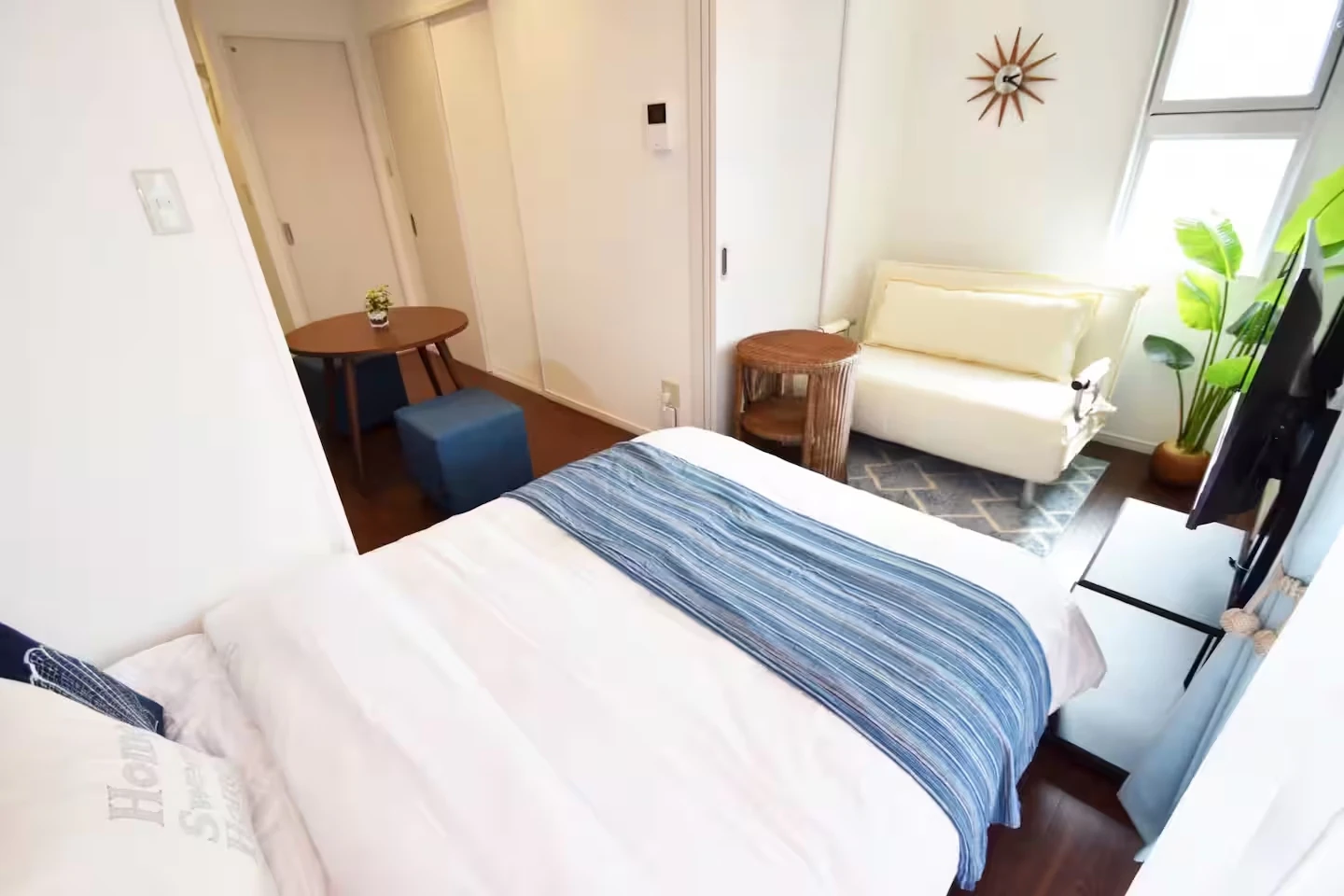
A base in Naha
Enjoy Maru 402 | For families and groups sharing one space
- Up to 6 guests; studio
- Kitchen and washing machine
- Elevator; paid off-site parking
A studio for up to 6 guests, with one double bed, one semi-double sofa bed and one semi-double futon set. It has a kitchen, washing machine and elevator, with paid off-site parking. Consider it if households don’t need separate bedrooms and everyone agrees on how to use the bedding.
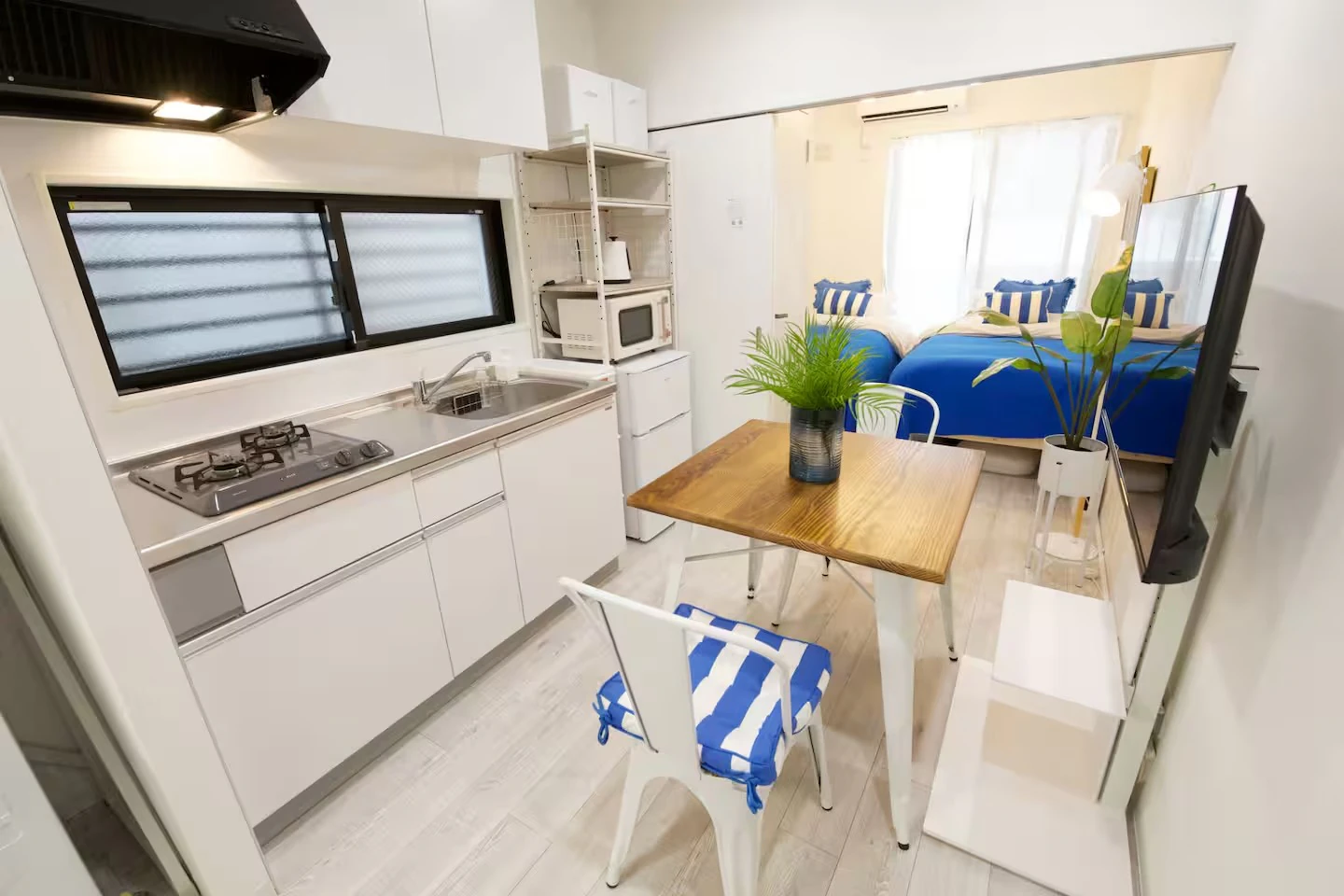
A base in Naha
GIRASOL 301 | Separate beds for 2, with washing and drying facilities
- Up to 2 guests; 1DK
- Washing machine and dryer
- 3rd floor; stairs required
A 1DK apartment for up to 2 guests with 2 single beds, a washing machine and dryer. It’s an option for trips that meet the booking conditions for 2 people, such as a couple or parent and child. On the 3rd floor without an elevator, it requires checking that walking and carrying luggage won’t be a problem for your companions.
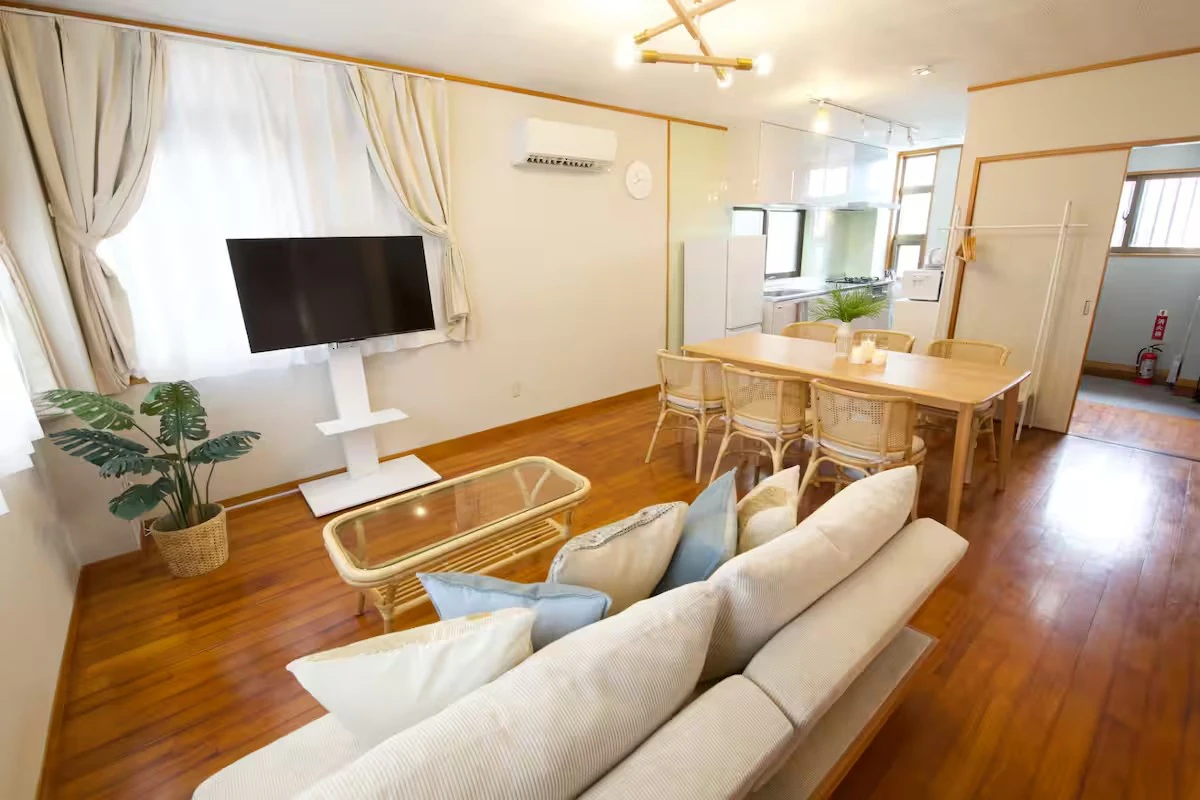
A base in Naha
AZUKI Heights 2F/3F | Multiple bedrooms for family trips
- Up to 9 guests; 3 bedrooms
- Kitchen and washing machine
- Free parking for 1 car
Up to 9 guests, 91 m² and 3 bedrooms. The listed facilities include 4 double beds, 1 sofa bed, a kitchen, washing machine and free parking for 1 car. Consider it when dividing rooms by household or bedtime. Before booking, confirm the bedding in each bedroom, bathroom turns and where a 2nd car would park.