

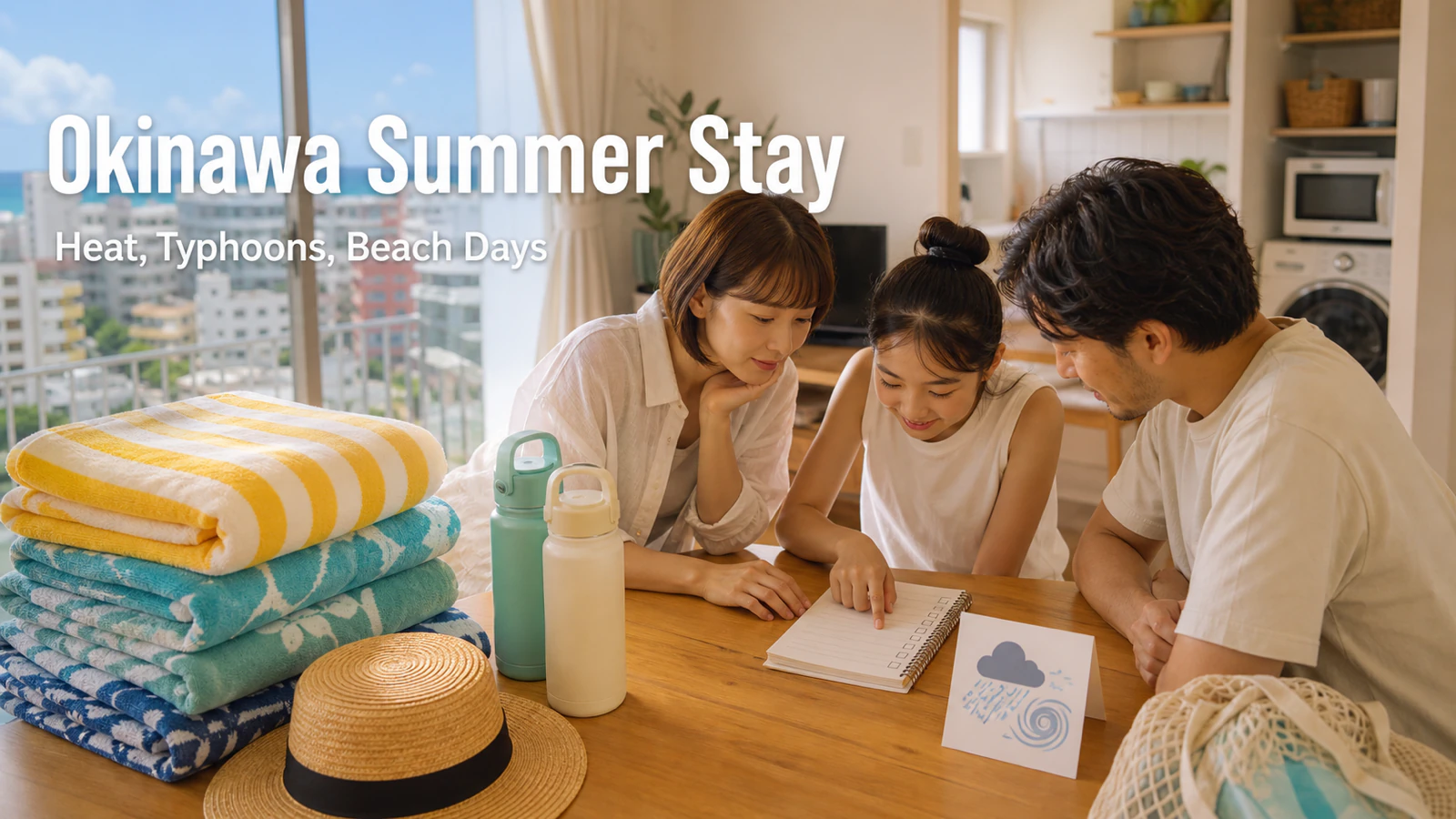
For Okinawa in July or August, accommodation should do more than put you close to the beach. Heat, wet gear, laundry, and possible weather changes all point to the same practical question: can everyone come back, cool down, and reset without stress?
TL;DR
- In July and August, choose Okinawa accommodation with heat, rest breaks, and indoor recovery time in mind.
- After beach days, laundry, storage space, and a layout that handles wet gear become genuinely useful.
- August does not need to be avoided, but your accommodation should allow flexible plans if a typhoon approaches.
- For families and groups, compare space, bedrooms, parking, kitchen, Wi-Fi, and laundry together.
- AZUKI Heights 2F and 3F is a practical Naha option for travelers who want a larger private base.
Start with the ability to rest and reset
Summer in Okinawa is rewarding, but it asks a lot from travelers. A day can include strong sun, beach time, driving, showers, laundry, and a fresh plan for the next morning. That makes your accommodation part of the travel system, not just the place where you sleep.
The Japan Meteorological Agency’s normal values for Naha show an average temperature of 29.1 C in July and 29.0 C in August. The average daily maximum is 31.9 C in July and 31.8 C in August. With those conditions, a good summer stay should make it easy to cool down, rest, wash clothes, and adjust the schedule (source: JMA Naha normal values).
What changes between July and August
July usually means strong post-rainy-season sun and the start of summer holiday demand. Naha’s normal sunshine duration is 227.0 hours in July, compared with 206.3 hours in August. That is good news for beach plans, but it also makes shade, hydration, and rest breaks more important.
August calls for a little more schedule flexibility. The Okinawa Meteorological Observatory’s PDF lists normal typhoon approach counts for Okinawa of 1.5 in July and 2.2 in August, based on the 1991 to 2020 normal period. This is not a reason to avoid August. It is a reason to avoid choosing a stay that only works when every outdoor plan goes exactly as expected (source: Okinawa Meteorological Observatory typhoon data).
The summer accommodation checklist
When you compare stays, picture the moment everyone returns from the beach, or the afternoon when weather changes the plan. The practical details become easier to judge.
| Item | What to check | Why it matters in July and August |
|---|---|---|
| Laundry | Whether a washing machine is easy to use during the stay | Swimwear, towels, rash guards, and sweaty clothes build up quickly |
| Kitchen | Whether breakfast, snacks, and drinks can be handled inside | Useful when heat, crowds, or tired children make eating out less appealing |
| Parking | Whether parking is free or paid, and how many spaces are available | Rental-car trips run more smoothly when parking is predictable |
| Space | Whether luggage and beach items can be opened without blocking movement | Beach gear, sandals, float toys, and spare clothes take up more room than expected |
| Wi-Fi | Whether everyone can check weather, flights, maps, and activity updates | Helpful during rain, delays, rest time, or itinerary changes |
| Location | Whether the stay works for the airport, town, and grocery stops | Flexible routes are valuable when the day’s plan changes |
This checklist is not about choosing the most luxurious stay. It is about reducing the number of small problems that appear during high-summer travel.
What matters after the beach
A single beach day can create a pile of wet and sandy items: swimsuits, rash guards, towels, children’s clothes, sandals, and bags. If clean clothes and wet gear end up in the same small space, the room can feel cramped very quickly.
Do not stop at checking whether a washing machine exists. Look for room to separate wet and dry items, a layout where several people can move at the same time, and a living area where tired travelers can sit down before heading back out. In summer, a stay should help you recover from the fun as much as it helps you reach it.
Build in room for typhoon-related changes
During months when typhoon approaches are possible, flights, ferries, and outdoor activities can be affected by weather. Before booking, ask a simple question: if you had to spend half a day indoors, would the accommodation still work?
The Okinawa Meteorological Observatory counts a typhoon approach when the center of a typhoon comes within 300 km of one of the listed weather stations in Okinawa Prefecture. Statistics cannot tell you what will happen on your exact travel dates, but they can remind you to leave room in the itinerary (source: Okinawa Meteorological Observatory typhoon statistics).
How families and groups should compare stays
The maximum guest count is only the start. A summer family or group trip also needs space for luggage, a place for children to rest, a table for planning the next day, and enough room for people with different schedules to move without constantly getting in each other’s way.
For multi-generation trips or trips with another family, one person may want an early beach start, another may need an afternoon nap, and someone else may want to do laundry at night. Bedrooms, living space, kitchen, Wi-Fi, and parking should be checked as one package.
A larger private base in Naha can make summer plans easier
Naha is useful for airport access, city errands, shopping, and route changes. If you want a base that works for arrival day, departure day, and weather-related adjustments, a larger private stay in Naha is worth comparing.
AZUKI Heights 2F and 3F is a private apartment in Naha. The official page lists 3LDK, about 91 sq m, up to 9 guests, about 19 minutes by car from Naha Airport, near Makishi Station, Wi-Fi, a full kitchen, a washing machine, and one free on-site residential parking space (source: AZUKI Heights 2F/3F official page).
Who it suits
It is especially easy to compare for families, groups of friends, multi-generation trips, and travelers who want to wash clothes, prepare simple meals, and rest indoors after summer outings. If you prioritize hotel restaurants, pools, daily housekeeping, and front-desk service, a hotel may be the better fit.
FAQ
Should I book early for an Okinawa trip in July or August?
For families and groups, yes. Stays that combine space, laundry, a kitchen, parking, and a convenient location can narrow quickly during summer holidays.
Where should I stay if I am worried about typhoons?
It depends on your itinerary, but Naha is practical around arrival and departure days because it keeps airport and city access simple. The more important point is to keep the schedule flexible.
If my trip is mainly about beach time, should I only look near the beach?
Beach access is helpful, but it is not the whole decision. After the beach, you still need laundry, a place to change, room to organize gear, and somewhere to rest.
Is a private apartment always better than a hotel in summer?
No. A private apartment works well when you value space, laundry, a kitchen, and group flexibility. A hotel may be better if you prioritize restaurants, pools, daily housekeeping, and staffed service.
Compare a larger private stay in Naha for your summer trip
AZUKI Heights 2F and 3F is about 19 minutes by car from Naha Airport and offers 3LDK, about 91 sq m, up to 9 guests, Wi-Fi, a full kitchen, a washing machine, and one free parking space.
View AZUKI Heights 2F and 3F