

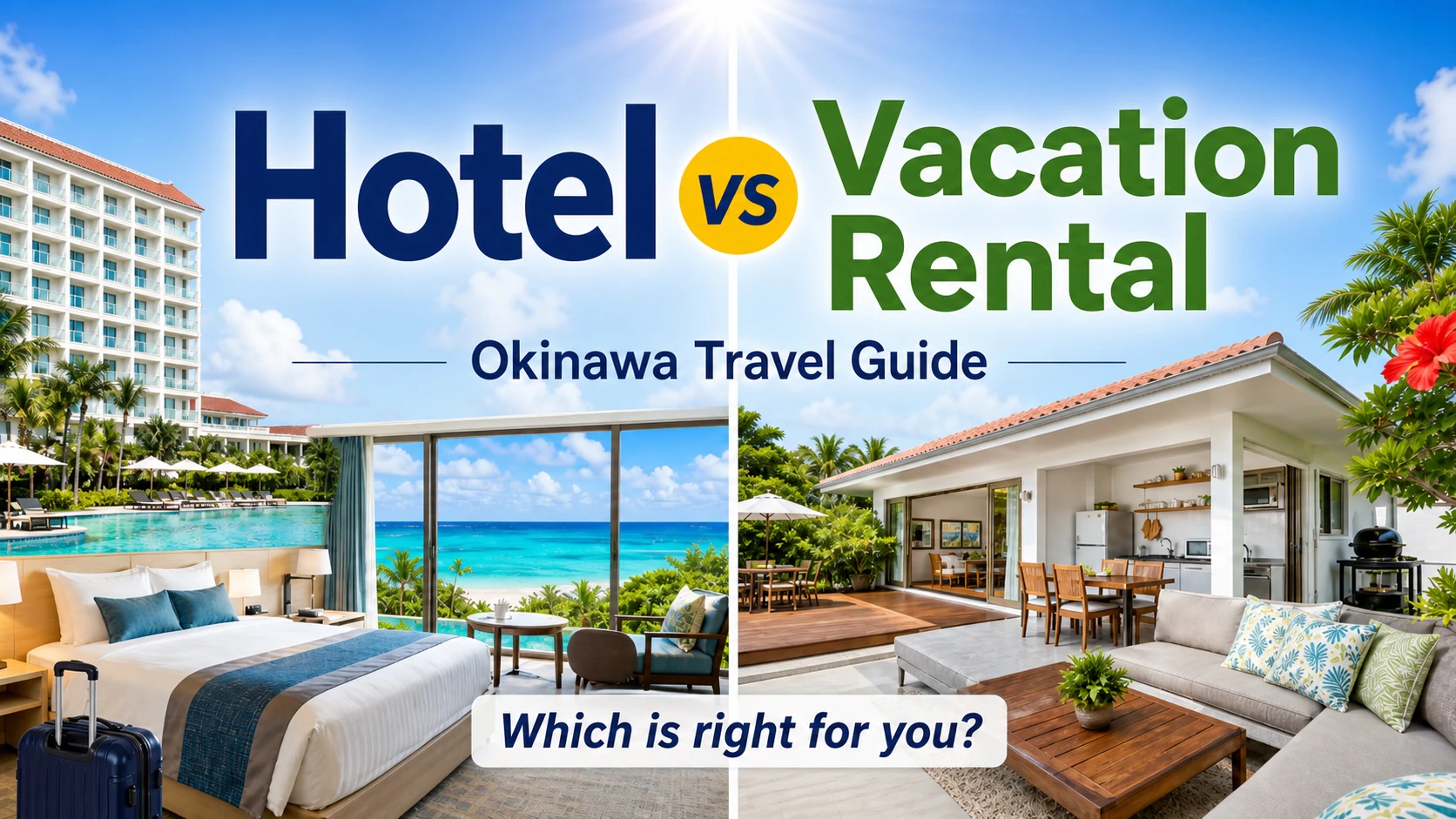
When you start planning a trip to Okinawa, where to stay is usually one of the first big decisions. Hotels are still the familiar choice, but private homes, vacation rentals, condominiums, and glamping stays give travelers far more options than before.
Okinawa recorded close to 11 million visitor arrivals in 2025, its highest annual total to date (source: Okinawa Prefecture visitor arrival overview). Interest in Okinawa continues to grow, with the destination also receiving international attention in travel rankings (source: Travel Voice).
TL;DR
- Okinawa hotels are straightforward to book and usually include front-desk support. Vacation rentals give you more room and more control over daily routines
- Do not compare stays by nightly rate alone. Space, facilities, location, and comfort per person matter too
- Okinawa vacation rentals often suit families, groups, and longer stays, especially when a kitchen or laundry space makes the trip easier
- Private rentals in Okinawa operate under notification or licensing systems, so review the listing details before you book
- The right stay depends on your purpose, group size, length of stay, and pace of travel
- Where you stay matters. Naha, central Okinawa, northern Okinawa, and beachside areas can make the same trip feel very different
- Okinawa’s accommodation tax is scheduled to start in February 2027 and applies to both hotels and vacation rentals
The basic difference between hotels and private rentals
The biggest difference is not the room type. It is how the stay actually works.
Hotels usually provide front desk support, daily housekeeping, room service, and other staff-led services. You have help close by from check-in through check-out.
Vacation rentals and private stays, such as whole-home rentals, condominiums, and private units, let you rent an entire home or unit. Self check-in is common, and the schedule is mostly your own. Many include a kitchen and washing machine, so a few days in Okinawa can feel less like passing through and more like settling in.
| Point | Hotel | Vacation rental / private stay |
|---|---|---|
| Service style | Staff on site, face-to-face service | Self check-in, stay at your own pace |
| Space | Guest room, usually one room | An entire home or unit |
| Kitchen | Usually not included, with some exceptions | Often included |
| Washing machine | Shared coin laundry | Often inside the unit |
| Meals | Hotel restaurants or room service | Cook for yourself or eat out |
| Parking | Often paid | Many include free parking |
| Best for | Short stays, sightseeing bases, travelers who value service | Longer stays, families, groups, travelers who want more freedom |
A seven-point comparison
1. Space and how you use it
A typical hotel twin room is usually around 20 to 30 square meters. Families and groups often need to split across multiple rooms.
Private rentals often give you 40 to 90 square meters or more, with separate living, sleeping, and kitchen areas. Everyone can gather in one place, which matters when the stay itself is part of the trip.
Picture it this way:
- Two hotel twin rooms may split a family of four or five into separate rooms
- A private rental lets everyone eat together in the living room, with space for adults to talk after the children go to bed
- A Japanese-style room can let the whole family sleep together on futons
How to decide: For two people on a short trip, a hotel room may be enough. For three or more people, or for longer stays, the extra space in a private rental often makes each day easier.
2. How to think about cost
Hotels are usually priced by room. As your group grows, you may need extra rooms or pay additional charges. Private rentals are often priced by home or unit, so the total may rise more slowly within the guest limit.
Costs that are easy to overlook:
- Hotel room rates can rise sharply in busy seasons
- With a whole-home rental, the cost per person often drops as the group gets larger
- Hotel parking often costs around 1,000 to 2,000 yen per night, while many private rentals include parking
- Using the kitchen can reduce the cost of eating out
- Hotel breakfast plans are convenient, but breakfast costs can add up for larger groups
How to decide: Hotels may be simpler for one or two people. For families or groups of four or more, private rentals are often better value when you compare the cost per person. Always compare the same dates, group size, and conditions.
Reference: cost image for a family of four, two nights
These figures are only a rough guide. Actual prices vary by property, season, and plan.
| Item | Hotel, two twin rooms | Private whole-home rental |
|---|---|---|
| Accommodation, two nights | 2 rooms x 2 nights = approx. 60,000 to 100,000 yen | 1 home x 2 nights = approx. 30,000 to 60,000 yen |
| Parking | Approx. 2,000 to 4,000 yen | Often free |
| Total | Approx. 62,000 to 104,000 yen | Approx. 30,000 to 60,000 yen |
| Per person | Approx. 15,500 to 26,000 yen | Approx. 7,500 to 15,000 yen |
For the same family of four, the cost per person can change a lot by stay type. Cooking in a rental kitchen can also keep meal costs down.
3. Facilities and amenities
Hotels usually provide towels, shampoo, hair dryers, and other basic amenities. Kitchens and in-room washing machines are uncommon.
Many private rentals include a kitchen with a stove, refrigerator, microwave, and tableware, plus a washing machine and Wi-Fi. Basic amenities such as towels and shampoo are also becoming common.
When those facilities help:
- Traveling with children: Warm baby food, prepare simple meals, and wash clothes during the stay
- Longer stays: Pack lighter because you can do laundry
- Group trips: Cook with Okinawan ingredients and make meals part of the experience
- Workations: Wi-Fi, a desk, and air conditioning make it easier to balance work and travel
How to decide: If you want to cook, do laundry, stay several nights, or pack lighter, a rental with a kitchen and washing machine is practical.
4. Privacy
Hotels have shared lobbies, elevators, and corridors. In a whole-home rental, the building is yours during the stay. Even in private units, contact with other guests is usually limited.
Privacy matters when:
- You have small children and worry about crying or footsteps
- Your group wants to talk late into the evening, while still being mindful of noise
- You want a quiet stay as a couple without thinking too much about other guests
- You want a slow breakfast on the terrace or in the living room
How to decide: If you want time and space for your own group, privacy is one of the biggest advantages of a private rental.
5. Location and access
Okinawa’s main island is roughly 120 kilometers long. Outside the Yui Rail area in Naha, most sightseeing is easier by car.
Hotels are concentrated in Naha and resort areas such as Onna Village. Private rentals are spread more widely, including Nakijin and Nago in the north, Onna and Ginowan in central Okinawa, and other bases suited to different sightseeing plans.
Choosing with Okinawa’s transport in mind:
- Naha city walks: a hotel along the monorail or a rental within walking distance of a station
- Churaumi Aquarium and northern Okinawa: a rental in Nago or Nakijin can be convenient, about 1.5 to 2 hours by car from Naha
- Onna resort area: both hotels and rentals are available near Manzamo and the Blue Cave
- Central Okinawa base: Ginowan or Chatan gives balanced access to northern and southern areas
How to decide: If you rent a car, staying near the places you plan to visit can reduce travel time. Make sure the property includes parking.
6. Check-in and support
Hotels have front desk staff and are reassuring for late check-ins or sudden issues. Hotels with concierge service can also help with sightseeing and restaurant questions.
Private rentals usually use self check-in. You can arrive on your own schedule, which often helps with late flights, but face-to-face support is limited. Many properties handle questions by message.
A typical self check-in flow:
- After booking, you receive check-in instructions by message
- On arrival, you enter with a smart lock or passcode
- Equipment instructions are provided in a guidebook or message
- Questions during the stay are handled by message
How to decide: Choose a hotel if in-person support helps you feel more comfortable. Choose self check-in if you want a flexible arrival and don’t want to plan around front desk hours.
7. Fit with your travel style
The right stay depends on the purpose of the trip.
| Travel style | Recommended | Why |
|---|---|---|
| Sightseeing all day, just need a place to sleep | Hotel | Simple, with housekeeping |
| Want time at the accommodation | Private rental | Comfortable living room and kitchen |
| Short stay, one or two nights | Hotel | Amenities make packing easy |
| Multi-night or longer stay | Private rental | Kitchen and laundry support daily life |
| Anniversary or surprise | Hotel | Staff support and special services |
| Family or group sharing one space | Private rental | Everyone can gather together |
| Workation | Private rental | Wi-Fi, desk space, and a quieter setting are easier to secure |
Types of stays you can find in Okinawa
Private stays in Okinawa come in several forms. Once you know the differences, it becomes easier to choose one that fits your trip.
Whole-home rentals
This means renting an entire house. You usually get a living room, multiple bedrooms, a kitchen, and sometimes a terrace, so larger groups have room to spread out. These are common in northern Okinawa, especially around Nago and Nakijin, where the setting is often quieter and closer to nature. Many also include parking.
Condominiums and private units
These are private rooms or units in an apartment or condominium building. They are often more affordable than whole-home rentals and are common in city areas such as Naha, Ginowan, and Chatan. Many include kitchens and washing machines, which helps on multi-night or longer stays.
Glamping
Glamping is an outdoor-style stay in a tent, dome, or similar accommodation with beds, a kitchen, and other comforts. You can stay close to nature without giving up the basics. Around Nakijin in northern Okinawa, glamping can also work as a base for Churaumi Aquarium and Kouri Island.
How to choose by area in Okinawa
Okinawa’s main island is broadly divided into southern, central, and northern areas. Each area feels different, and choosing the right base can make the whole trip smoother.
Naha area, southern Okinawa
- Character: Kokusai Street, Shuri Castle, and the convenience of the monorail
- Hotel options: Many, including business hotels and city hotels
- Rental style: Mostly compact condominium-style units near stations, useful for walking around the city
- Best for: Travelers without a rental car, or the first or final night near the airport
Ginowan and Chatan, central Okinawa
- Character: American Village, Tropical Beach, and large shopping centers
- Hotel options: Resort hotels along the Chatan waterfront
- Rental style: Many condominium-style stays, often close to supermarkets and convenience stores
- Best for: Travelers visiting both north and south, or those who want plenty of dining and shopping nearby
Onna Village, central to northern Okinawa
- Character: Manzamo, the Blue Cave, and beach resort areas
- Hotel options: Many large resort hotels with pools, spas, and restaurants
- Rental style: Private units near resort areas, often with a quieter feel than hotels
- Best for: Travelers who like the resort area but still want private space
Nago and Nakijin, northern Okinawa
- Character: Churaumi Aquarium, Kouri Island, Yanbaru nature, and Junglia Okinawa, a nature-based theme park scheduled to open in July 2025
- Hotel options: Some resort hotels, but fewer choices than central and southern Okinawa
- Rental style: Many whole-home rentals and glamping stays set around natural surroundings
- Best for: Travelers focused on northern Okinawa, quiet nature stays, and larger group trips
Recommended patterns by trip length
One night, two days
- Recommended: Hotel or condominium in Naha
- Why: Prioritize airport access, unpack less, and keep more time for sightseeing
Two nights, three days
- Recommended: A private rental near your main destination, or one night in a hotel plus one night in a rental
- Why: With two nights, you have enough time to use a kitchen or washing machine
Three nights, four days or longer
- Recommended: Split your stay between two areas
- Why: For example, stay in central Okinawa such as Ginowan first, then move to northern Okinawa such as Nago or Nakijin to reduce driving time
Who each option is best for
Hotels are best for travelers who:
- Are traveling with one or two people for a short stay
- Value in-person service and daily housekeeping
- Feel reassured by staff support on a first visit
- Want to use hotel facilities such as restaurants or public baths
- Expect special arrangements for an anniversary or celebration
- Want to pack light
Private rentals are best for travelers who:
- Are traveling as a family or group of three or more
- Want to cook or do laundry during a multi-night stay
- Plan to spend meaningful time at the accommodation
- Have children and want fewer worries about noise
- Want a stay that feels closer to everyday life in Okinawa
- Want to stay closer to local residential areas
- Plan to travel by rental car
- Want to save on parking costs
You can also combine both
For trips of three nights or more, mixing both styles can work well. You might rest in a full-service hotel on arrival day, then move to a private rental closer to your sightseeing base the next day.
Are Okinawa vacation rentals safe? Checking the legal framework
Some travelers feel unsure when they hear the word minpaku, or private lodging. In Okinawa, operating this type of accommodation requires either notification under the Private Lodging Business Act or permission under the Hotel Business Act (source: Okinawa Prefecture private lodging page).
Properties with the required notification or permission operate after meeting safety and hygiene standards.
Key points of the Private Lodging Business Act
- The law took effect in June 2018 and sets rules for using homes as accommodation
- Notification to the prefecture is required
- Operations are limited to 180 days per year
- Safety measures such as emergency lighting are required
- A notification number is issued
Source: Okinawa Prefecture private lodging page
Permission under the Hotel Business Act
- Facilities operating more than 180 days require permission under the Hotel Business Act
- Many operate with permission as simple lodging facilities
- Like hotels, they have passed review by the public health center
How to identify safer properties
- Major platforms such as Airbnb verify notification numbers for listed properties
- Check whether a notification or permit number appears on the property page
- Choose properties that clearly show operator contact details and inquiry methods
- Reviews can show how previous guests actually found the stay
Reference: Accommodation tax is scheduled for February 2027
Okinawa Prefecture is scheduled to introduce an accommodation tax on February 1, 2027. The tax rate is 2% of the accommodation charge per person per night, capped at 2,000 yen. It applies to hotels, ryokan, private lodging, and vacation rentals (source: Okinawa Prefecture accommodation tax page).
For example, a 10,000 yen room night would add 200 yen, and a 25,000 yen room night would add 500 yen. If a municipality also applies its own accommodation tax, the prefectural portion is planned at 0.8% and the municipal portion at 1.2%, keeping the combined rate at 2%.
The tax rate does not change by accommodation type. Starting in 2027, include this tax when planning your travel budget.
Five checks to avoid choosing the wrong stay
When deciding between a hotel and a private rental in Okinawa, these five checks can make the choice clearer.
1. Group size
For three or more people, a private rental often becomes more useful. For groups of five or more, sharing one home can feel more natural than booking several hotel rooms.
2. Length of stay
For two nights or more, a kitchen and washing machine become more valuable. For stays of three nights or longer, doing laundry during the trip can reduce luggage.
3. Transport
If you have a rental car, private rentals give you more area choices. Choosing a stay with free parking can also save the 1,000 to 2,000 yen per night often charged by hotels.
4. How you want to spend time
If the stay is only for sleeping after sightseeing, a hotel may be enough. If you want slow breakfasts, quiet evenings, or time in the accommodation itself, a rental with a living room and kitchen is more comfortable.
5. Budget
Do not compare only the room price. Look at the cost per person and the total cost, including parking, breakfast, and possible savings from cooking some meals yourself.
FAQ
It depends on the property, but many private rentals provide basic items such as towels, shampoo, body soap, and hair dryers. Kitchens often include cookware and tableware. Check the facility list on the property page before booking.
There is no single answer. For one or two people on a short stay, a hotel can be more affordable. For groups of four or more, or for longer stays, private rentals are often cheaper per person. Compare the total cost, including parking and meals.
They can be very practical. A kitchen helps with baby food and children’s meals, a washing machine helps with clothes, and the extra space gives children room to move. Families with preschool-age children may especially appreciate the flexibility around meals and laundry.
Yes. If you book through a reservation site, the process is similar to booking a hotel. Check-in instructions and facility details are usually sent in advance by message. If you feel unsure, choose a property with many reviews and clearly stated support options.
The biggest benefit is that everyone can stay in the same space. Instead of splitting into hotel rooms, you can gather in the living room for meals and conversation. Lower cost per person and included parking are also major advantages.
In Okinawa, options include whole-home rentals, private condominium units, and glamping facilities. Choose based on group size, area, budget, and the kind of stay you have in mind.
If you only plan to stay in Naha, the monorail, buses, and taxis may be enough. If you want to visit central or northern spots such as Churaumi Aquarium, Kouri Island, or Manzamo, a rental car gives you much more freedom. Many private rentals are easier to use with a car.
For both hotels and private rentals, check-in is commonly from 4:00 p.m. and check-out before 11:00 a.m. Times vary by property, so confirm when booking.
It is scheduled to begin on February 1, 2027. The tax is 2% of the accommodation charge per person per night, capped at 2,000 yen. Hotels, private lodging, and vacation rentals are all covered, with no difference in rate by stay type. It is collected by the accommodation provider.
Summary
Whether a hotel or a private rental is better depends on the purpose of your trip, the number of people, the length of stay, and the way you want each day to feel.
- Choose a hotel if you value convenience, service, and reassurance
- Choose a private rental if you value space, freedom, and cost performance
- For families and groups who want to share one space, private rentals are especially useful
- If you want a more residential style of travel in Okinawa, a stay with a kitchen and washing machine is a strong choice
The key is to avoid treating it as a simple hotel-versus-minpaku question. Choose the stay type that fits your own travel style. Use the seven comparison points and practical checks in this guide to find the right base for your Okinawa trip.
Interested in a private rental?
If this guide made you want a stay with a kitchen and enough space for family or friends, take a look at Hana House 401 in Ginowan. It is a 65 sq m private unit with two bedrooms, a full kitchen, a washing machine, and space for up to seven guests. Located between Chatan and Naha, it also works well as a base for exploring central Okinawa.
See Hana House 401