

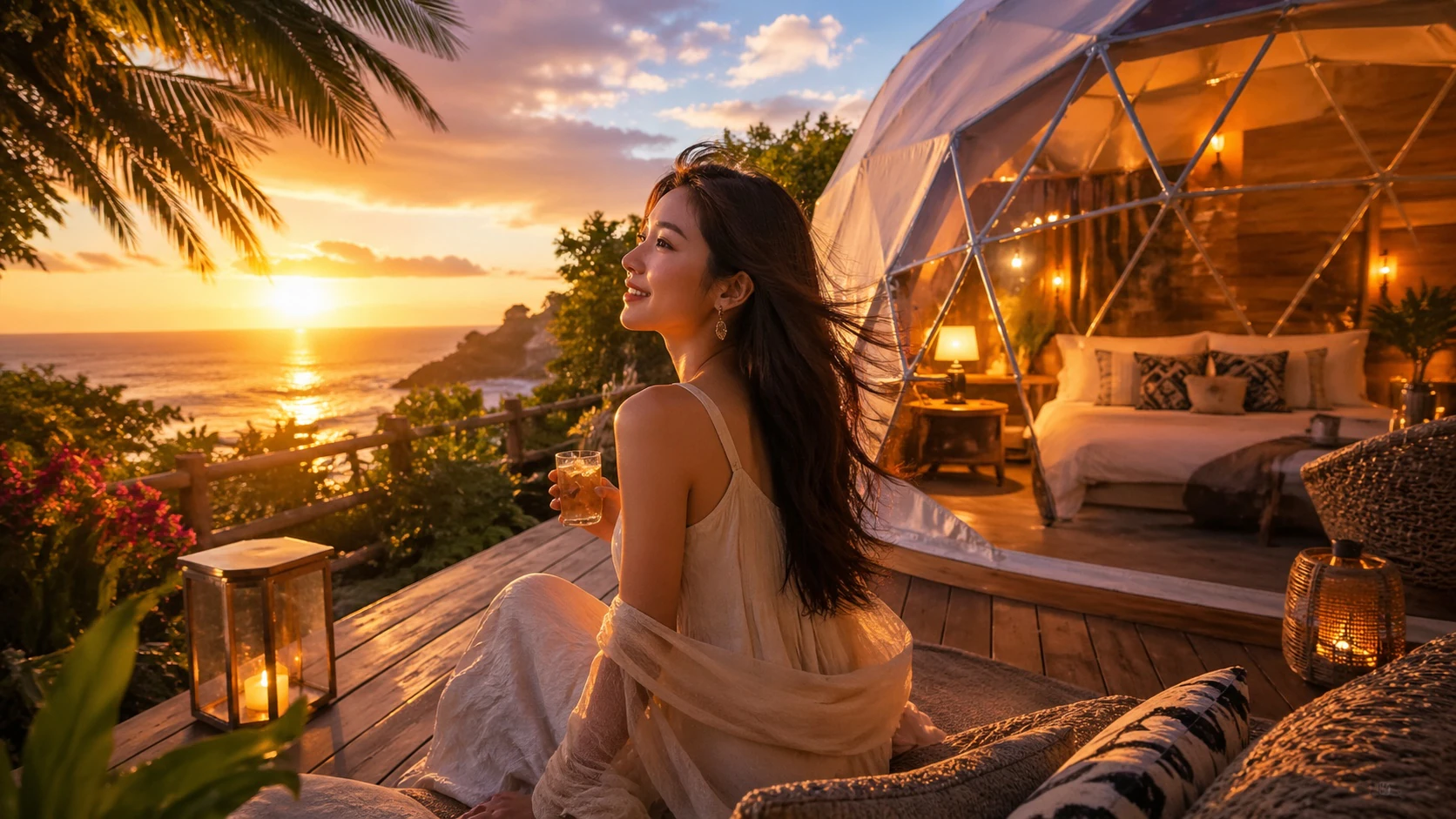
“I keep hearing about glamping, but what is it actually like?” “How is it different from staying at a hotel?” “Can I enjoy it even if camping isn’t really my thing?”
Travelers ask these questions often, especially when planning a trip to Okinawa, where glamping has become a real alternative to a standard hotel stay.
This guide explains what glamping is, how it compares with hotels and camping, what makes it work in Okinawa, typical costs, and how to choose a facility, with an accommodation-focused travel perspective.
By the end, you’ll have a clear sense of whether glamping fits the way you want to travel.
What You’ll Learn in This Article
- What glamping is and what the experience involves
- How it differs from hotels and camping in amenities, cost, preparation, and pace
- Why glamping works especially well in Okinawa
- Typical glamping costs
- Who glamping suits, and who may prefer another style of stay
- Key tips for choosing the right facility
What Is Glamping? The Basics
Glamping is a portmanteau of “glamorous” and “camping”. It refers to a style of accommodation where you can spend time close to nature while still having comfortable amenities and services (Travelko).
Traditional camping asks you to handle the tent, meals, and cleanup yourself. With glamping, furnished tents or cabins, meals, beds, toilets, and showers are prepared for you. Many facilities also have air-conditioned rooms (Travelko).
Put simply, glamping gives you an outdoor stay without the usual camping workload. It’s become popular with people who want to enjoy nature but don’t own camping gear, or who feel unsure about sleeping in a tent.
Types of Glamping Facilities
Glamping facilities come in several forms. Across Japan, they generally fall into four main categories (Kanko Mie):
- Dome Tents: Spherical tents with an open, airy feel. Many travelers like the distinctive look
- Cabins: Wooden cottages with a camping mood and solid protection from wind and rain
- Cottages / Villas: Standalone buildings with well-equipped interiors and strong privacy
- Trailers: Vehicle-based accommodations with a different feel from ordinary rooms
In Okinawa, dome tents and cottage/villa-style facilities are the most common. Amenities and the overall “outdoor” feel vary a lot by facility, so choose a type that matches how close to nature you actually want to be.
Glamping vs. Hotels vs. Camping: A Detailed Comparison
To understand what glamping offers, it helps to compare it with hotels and camping across a few practical points.
Amenities and Comfort
Hotels keep everything indoors: climate control, beds, a private bath, toiletries, Wi-Fi, and room service. For predictable comfort, they are the most reliable option.
Glamping facilities typically offer beds, heating and cooling, power outlets, and showers or toilets. You get comfort close to a hotel while staying much closer to nature. Amenities still vary by facility; some may not have Wi-Fi, and bathrooms may be shared.
Camping requires you to bring and set up your own tent, sleeping bag, cookware, and other gear. Many campsites have limited electricity or running water. Of the three, camping puts you closest to nature.
Preparation and Convenience
Preparation is where the three styles differ most clearly.
- Hotels: Book and show up. A change of clothes is usually enough
- Glamping: Most essentials for the stay are usually provided by the facility
- Camping: You need to purchase and bring your own tent, sleeping bag, cooking gear, food, lantern, and more
Glamping removes much of the prep work that can make camping feel difficult, while still giving you time outdoors in a way hotels usually don’t.
Dining Options
- Hotels: On-site restaurants and room service with plenty of choices
- Glamping: BBQ plans are common. Some facilities supply ingredients, while units with kitchens also allow self-catering
- Camping: You buy the groceries, cook the meal, and clean up afterward
In Okinawa, some glamping facilities offer BBQ meal plans while others provide kitchen setups for self-catering. The dining style you want should influence where you book.
How You Spend Your Time
- Hotels: Time tends to center on on-site facilities such as pools, spas, and restaurants. Hotels also work well as efficient sightseeing bases
- Glamping: The setting is part of the stay. Stargazing, waking up to morning light, and eating outdoors create a slower rhythm than a typical hotel trip
- Camping: The hands-on work, such as pitching a tent, building a fire, and cooking, is part of the enjoyment. Doing it yourself brings its own sense of accomplishment
What sets glamping apart is that it lets you stay close to nature without giving up most hotel-level comforts.
Comparison at a Glance
| Category | Hotel | Glamping | Camping |
|---|---|---|---|
| Preparation | Just book | Most essentials provided | Gear and supplies required |
| Amenities | Fully equipped | Varies (beds, A/C, and plumbing common) | Minimal or self-supplied |
| Dining | Restaurants, etc. | BBQ plans or self-catering | Self-catering only |
| Closeness to Nature | Low | High | Very high |
| Comfort | High | Medium to high | Low (depends on your gear) |
| Sense of Escape | Moderate | High | High |
| Best For | Those who prioritize comfort | Those who want both nature and comfort | Experienced outdoors enthusiasts |
Why Travelers Choose Glamping in Okinawa
When most people think of an Okinawa trip, resort hotels come to mind. In recent years, though, more travelers have been choosing glamping. Okinawa’s setting explains much of that shift.
1. A Closer Feel for Okinawa’s Subtropical Nature
Okinawa has a subtropical climate, with plants and scenery that feel quite different from mainland Japan. Glamping lets you feel that natural setting firsthand in a way that’s hard to get from inside a hotel room.
In northern Okinawa (the Yanbaru area), you’re surrounded by dense greenery. On clear nights, the sky fills with stars. The farther you are from city lights, the more noticeable it becomes.
2. Private, Whole-Unit Stays
Many glamping facilities in Okinawa offer private whole-unit or private-site accommodations. Unlike hotels, you rarely have to share common spaces with other guests, which appeals to families or groups who want a relaxed, private stay.
For families with small children, that privacy also reduces the worry of bothering other guests.
3. A Natural Fit for the “Live Like a Local” Travel Style
Glamping feels different from a trip built around rushing between sightseeing spots. The stay itself becomes part of the purpose, which suits travelers who want to take in Okinawa at a slower pace.
If the facility has a kitchen, shopping for local ingredients and cooking for yourself can be part of the fun. Island vegetables and fresh seafood from Okinawa’s markets and supermarkets give the trip a more local rhythm.
4. A Convenient Base for Exploring Northern Okinawa
Northern Okinawa is home to popular attractions like Churaumi Aquarium, Kouri Island, Nakijin Castle Ruins, and JUNGLIA Okinawa (opened in 2025). Staying in the north means less time driving and more time at these destinations.
Since the drive from Naha to the north takes roughly 1.5 to 2 hours, a northern glamping base can make the whole area easier to explore.
Amenities and Services at Okinawa Glamping Facilities
Amenities differ by facility, but these are the features you’ll commonly see at glamping facilities in Okinawa.
Sleeping Arrangements
- Beds: Singles, doubles, sofa beds, and more. A real bed instead of a sleeping bag is one of the clearest differences from camping
- Air Conditioning: Many facilities are fully air-conditioned. In Okinawa’s hot summers, A/C matters a lot
- Electrical Outlets: Indoor outlets are standard, so you can charge your phone easily
Bathroom Facilities
- Shower / Bath: Most facilities have a private or on-site shower or bathroom. Some offer shared facilities only
- Toilet: Either inside the unit or within the facility grounds
- Toiletries: Shampoo, body wash, and towels are commonly provided
Kitchen and Dining
- BBQ Setup: Some facilities offer BBQ plans with ingredients included; others provide only the grill and space
- Kitchen: Some units come with a stove, refrigerator, microwave, cookware, and tableware, so you can cook your own meals
Other Amenities
- Washing Machine: Available at some facilities, useful for longer stays
- Parking: Since rental cars are the standard mode of transport in Okinawa, most facilities offer on-site parking
- Wi-Fi: Coverage varies. Some facilities don’t offer it, so check before booking
Key Amenities to Confirm Before Booking
- Air conditioning: Essential in summer, when temperatures regularly exceed 30°C
- Private vs. shared bathroom: If privacy matters to you, choose a facility with its own bathroom
- Kitchen details: If you plan to cook, verify whether there’s a stove and refrigerator
- Wi-Fi: Important if you plan to work remotely or need reliable internet access
- Parking capacity: For group trips with multiple cars, confirm how many vehicles can be accommodated
How Much Does Glamping Cost?
Cost is naturally a key factor when choosing an accommodation style.
Typical Glamping Price Range
As a general nationwide benchmark, glamping runs around ¥15,000–¥20,000 per adult per night for accommodation only, or around ¥20,000–¥30,000 with dinner and breakfast (Kanko Mie).
Prices in Okinawa vary depending on location, season, and facility grade. The more people in your group, the lower the per-person cost tends to be. At some facilities, groups can bring the cost down to around ¥10,000 per person (Kanko Mie).
Cost Comparison Across Accommodation Types
| Accommodation Type | Approx. Cost per Person / Night | Notes |
|---|---|---|
| Camping | A few thousand yen (site fee) | Assumes you already own gear. Initial equipment costs can be significant |
| Glamping | ¥15,000–¥30,000 | Varies by meal plan and facility grade. Larger groups pay less per person |
| Business Hotel | ¥5,000–¥10,000 | Basic amenities. Primarily valued for location convenience |
| Resort Hotel | ¥15,000–¥50,000+ | Full-service amenities. Wide price range |
Glamping usually costs more than camping, and about the same as or slightly less than a resort hotel. If you don’t already own camping gear, though, glamping may cost less overall than buying everything for a camping trip from scratch.
Cost Factors to Keep in Mind
- Seasonal fluctuations: Peak season in Okinawa (July–September, New Year’s, Golden Week) typically brings higher rates
- Meal plans: BBQ plans with ingredients are convenient but add to the price. Self-catering facilities tend to have lower base rates
- Group size savings: Whole-unit rentals become more affordable per person as the group grows
- Additional fees: Some facilities charge separately for linens, cleaning, or parking. Confirm the total before booking
A Sample Day at an Okinawa Glamping Facility
If you’ve never tried glamping before, it can be hard to picture the day-to-day flow. Here’s one example of a stay at a glamping facility in northern Okinawa.
Morning: Savor the Quiet Hours Before Checkout
- Wake up surrounded by nature, with a freshness that’s hard to get in a hotel room
- If the facility has a kitchen, use ingredients you picked up the day before to prepare breakfast
- Enjoy your meal on the terrace or outdoor area, taking in the Okinawan morning air
Daytime: Explore Nearby Attractions
- With a base in the north, you can visit Churaumi Aquarium, Kouri Island, Nakijin Castle Ruins, and JUNGLIA Okinawa during the day
- Being based in the north saves significant driving time compared to making the round trip from Naha
- Stop by a local market or supermarket to pick up ingredients for dinner. That errand can become part of the trip
Evening: Unwind at Your Facility
- Fire up the BBQ or use the kitchen to prepare dinner. Eating outdoors makes even a simple meal feel special
- If you’re in an area with little light pollution, the night sky can be striking
- Wind down with the sounds of insects and the breeze around you
Glamping is an accommodation style where the stay itself can become the highlight of your trip. It suits travelers who’d rather slow down and enjoy where they are than rush through a checklist of sights.
Is Glamping Right for You?
Glamping isn’t the right choice for everyone. Knowing in advance whether it suits your travel style can make a big difference in how much you enjoy the experience.
Glamping Is a Good Fit If You…
- Want to be in nature but don’t own camping gear: You can enjoy the outdoors without bringing a thing
- Are curious about camping but uneasy about tent sleeping or cooking outdoors: Proper amenities take the worry out of it
- Are traveling with small children: A private whole-unit rental means no worrying about noise. Real beds and A/C keep kids comfortable
- Want your family or group under one roof: Whole-unit or private-site options let everyone stay together
- Are looking for something different from the usual hotel stay: Glamping gives the trip a stronger sense of escape
- Want to spend more time in Okinawa’s natural environment: It works well for trips where the stay matters as much as sightseeing
Glamping May Not Be for You If You…
- Expect full-service comfort: There’s no room service or concierge. A hotel would suit you better
- Really dislike bugs: Being close to nature means you’re more likely to encounter insects than at a hotel
- Need reliable Wi-Fi at all times: Not all facilities offer it, so check in advance
- Prioritize easy access above all else: Glamping facilities tend to be in nature-rich areas, often away from urban centers
- Want a rugged, hands-on outdoor experience: Glamping may feel too comfortable for experienced campers who love the DIY aspect
Not Sure? Ask Yourself These Three Questions
If you’re on the fence, these three questions can help you narrow it down:
- “Do I want to be surrounded by nature, or do I prefer a convenient, central location?”
- “Do I enjoy handling setup and cleanup myself, or would I rather have it taken care of?”
- “Do I value a sense of escape, or do I prioritize comfort and services?”
Your answers should point you toward the accommodation style that fits best.
How to Choose a Glamping Facility You Won’t Regret
Glamping facilities vary widely in concept and amenities. To avoid arriving and thinking, “This isn’t what I expected,” check these points before you book.
Tip 1: Match the Location to Your Purpose
Okinawa is long from north to south, and each area has its own character.
- North (Nago, Nakijin, Motobu): Rich natural scenery and a calm setting. Home to Churaumi Aquarium, Kouri Island, and Nakijin Castle Ruins. Good for travelers who want to relax in nature
- Central (Onna, Yomitan, Chatan): The resort belt. Coastal facilities with easy beach access
- South (Naha, Nanjo): Close to the city with more dining and shopping options. Glamping facilities are relatively scarce here
The best area depends on your goals. If you want sightseeing and time in nature in the same trip, northern Okinawa is a strong contender.
Tip 2: Check Amenities in Detail
The word “glamping” covers a wide range of setups. Check the details carefully:
- Air conditioning
- Private or shared bathroom
- Kitchen availability and what equipment is provided
- Washing machine (important for multi-night stays)
- Clothes dryer (helpful in Okinawa’s humidity)
- Wi-Fi
- Parking availability and capacity
- Number and configuration of beds (enough for your party?)
Tip 3: Look at Capacity and Floor Plan
For families or groups, check the floor plan and bed configuration as well as the maximum capacity. A unit listed as “up to 6 guests” can feel very different depending on whether it’s one open room or multiple separate spaces.
Tip 4: Confirm Your Dining Options
- Is a BBQ plan with ingredients available?
- Is there a kitchen for self-catering?
- Are there restaurants or supermarkets nearby?
Facilities in northern Okinawa in particular may be located in areas with few nearby restaurants. Planning your meals in advance will save you from surprises.
Tip 5: Check Check-in and Check-out Times
Check-in at glamping facilities is typically around 3:00–4:00 PM, similar to hotels. If you’re heading to a facility in northern Okinawa, remember that the drive from Naha Airport takes a while. Build some buffer into your schedule.
Tip 6: Prepare for the Season and Weather
Okinawa’s climate is different from the mainland.
- Summer (June–September): High temperatures and strong UV. Air conditioning is a must. Sun protection and hydration are essential
- Rainy season (mid-May to late June): Frequent rain. A facility with a covered terrace or spacious interior helps
- Autumn–Winter (October–February): Warmer than mainland Japan but sometimes windy. Bring some wind and cold protection
- Spring (March–April): Mild and stable weather. One of the most comfortable periods for glamping
A facility with solid construction and enough indoor space will make the stay easier when the weather changes.
The Appeal of Glamping in Northern Okinawa
Among Okinawa’s glamping options, the northern area (around Nago, Nakijin, and Motobu) is especially easy to recommend.
Abundant Natural Beauty
Northern Okinawa, also known as Yanbaru, is home to some of the island’s least urbanized natural landscapes. You’ll find subtropical forests, vivid blue ocean, and, at night, stars that are hard to see from the city. It’s a strong setting for what glamping is meant to offer: time spent among nature.
Easy Access to Top Attractions
The north is where many of Okinawa’s most popular spots are concentrated:
- Okinawa Churaumi Aquarium: One of Okinawa’s classic stops
- Kouri Island: Known for its blue water and the iconic Kouri Bridge
- Nakijin Castle Ruins: A UNESCO World Heritage gusuku site
- JUNGLIA Okinawa: A theme park that opened in 2025
With a base in the north, you can reach all of these in a short drive. Sightsee during the day, then return to a quieter natural setting at night.
Strong Privacy
Compared to resort areas in Naha or central Okinawa, glamping facilities in the north tend to sit in quieter, more secluded surroundings. A whole-unit rental gives your family or group its own space, without the usual hotel-style shared areas.
Frequently Asked Questions
The biggest difference is whether you need to prepare your own gear. With camping, you bring your own tent, sleeping bag, and cooking equipment and handle setup and takedown yourself. With glamping, the main things you need are already at the facility, so you can arrive with much less preparation. Many glamping sites also feature comfortable bedding, climate control, and proper bathroom facilities, making them approachable even for outdoor beginners (Travelko).
Since bedding and toiletries are usually provided, a change of clothes, sunscreen, insect repellent, and any personal medication are typically all you need. For Okinawa, pack UV protection essentials such as sunglasses, a hat, and sunscreen, and keep some drinks handy for the car ride. If the facility doesn’t have Wi-Fi, make sure you have a mobile data plan sorted out.
The nationwide benchmark for glamping is around ¥15,000–¥20,000 per adult per night (accommodation only) or ¥20,000–¥30,000 with meals (Kanko Mie). Facilities in Okinawa generally fall within this range, though prices vary by season and grade. With whole-unit rentals, the per-person cost tends to drop as the group size increases.
Yes. Whole-unit glamping facilities are a particularly good match for families with kids. The privacy means you don’t have to worry as much about noise, real beds and air conditioning keep everyone comfortable, and a kitchen (if available) lets you prepare meals on your own schedule. Some remote facilities may have limited access to shops or medical services, so check those details in advance.
If the facility has a solid building structure, rain shouldn’t be a problem. You can spend the day comfortably indoors. At facilities with a kitchen, cooking together is a good rainy-day activity. If you’re planning a trip during an unpredictable weather window, choose a place with enough indoor space and amenities to keep your group comfortable.
For amenities and service, hotels generally come out ahead. Room service, concierge desks, on-site restaurants, and spas are things glamping usually doesn’t offer. Glamping has the advantage when it comes to privacy, closeness to nature, and a real sense of getting away. Which one feels more comfortable depends on what matters most to you.
The most pleasant months are March–April (spring) and October–November (autumn), when temperatures are mild and the weather is relatively stable. Summer (July–September) is Okinawa’s peak season and has the best beach weather, but the heat is intense, so make sure the facility has air conditioning. During the rainy season (mid-May to late June), choose a facility with enough indoor space for a comfortable day inside.
Summary
Glamping is an accommodation style that pairs time in nature with the comfort of a well-equipped stay. With no tent to pitch and no gear to pack, it gives first-time outdoor travelers and families with small children an easier way to spend time outdoors.
In Okinawa, the northern region (around Nago, Nakijin, and Motobu) has seen a growing number of glamping facilities that make use of the area’s rich natural environment. A trip might combine daytime visits to Churaumi Aquarium or Kouri Island with quiet evenings surrounded by nature.
When choosing a facility, check the location, available amenities, dining options, capacity and floor plan, and Wi-Fi availability in advance. Those details will make your first glamping stay much easier to enjoy.
If glamping sounds like it might fit your trip, start by comparing specific facilities and seeing which one matches your plans.
Interested in Glamping in Northern Okinawa?
Half Glamping Hoshine Unit C is a private whole-unit glamping facility in Nakijin Village. It’s about a 20-minute drive from both Churaumi Aquarium and Kouri Island, so it works well as a base for exploring the north. It comes with a kitchen, washing machine, and dryer, and accommodates up to 6 guests.
View Half Glamping Hoshine Unit C