

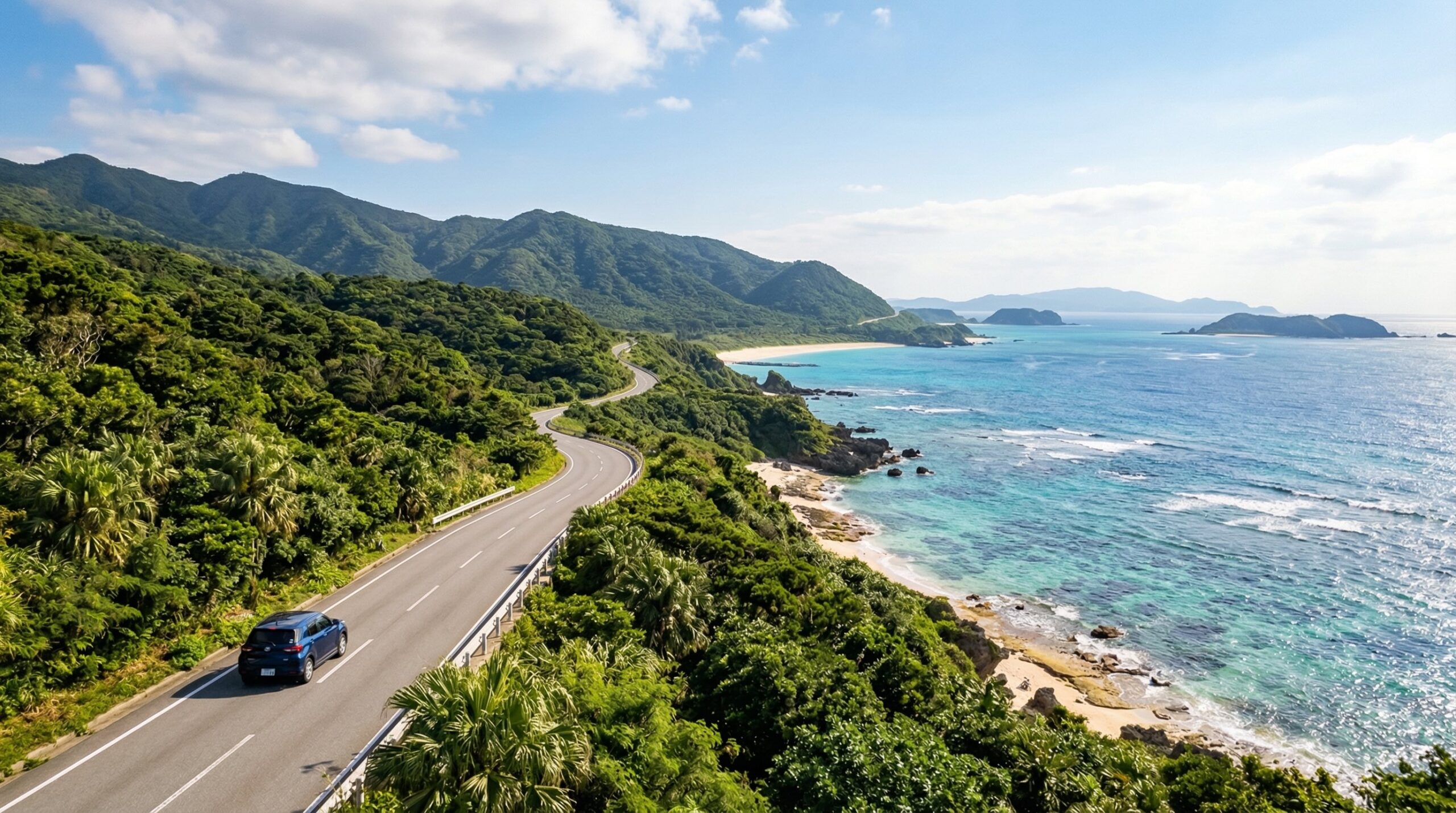
From Kouri Bridge, where it feels like you are driving over the sea, to Cape Hedo at the northern tip of Okinawa’s main island, and on into the deep green forests of Yanbaru. If you want to make the most of northern Okinawa in a single day, staying in Nago and following a route that heads north is one of the easiest ways to plan it. Nago City is officially described as the “gateway to Yanbaru,” and its location makes it easy to reach both the east and west coasts as well as the mountain areas further north.
The northern part of Okinawa Island also includes areas within the UNESCO World Natural Heritage property registered in 2021 as “Amami-Oshima Island, Tokunoshima Island, Northern Part of Okinawa Island, and Iriomote Island.” The registered area itself is mainly in Kunigami, Ogimi, and Higashi Villages, so Nago City is not part of the core heritage zone. Even so, one of Nago’s biggest advantages is how convenient it is as a base for reaching both dramatic ocean views and forests recognized for their global natural value.
In this article, we’ll cover not just the photogenic highlights, but also the most practical order to visit them, the latest conditions travelers should know right now, and how to choose a place to stay that works well for a northern Okinawa road trip.
What you’ll find in this article
- The easiest order for exploring northern Okinawa when starting from Nago
- Highlights of Kouri Bridge, Cape Hedo, Asumui Hikes, and Gesashi Bay
- How to appreciate Yanbaru in the context of the World Natural Heritage site
- Key updates to check as of March 2026
- What to look for when choosing accommodation for a northern Okinawa drive
The short answer: From Nago, the smoothest flow is west coast ocean views, the northern tip, then back down the east coast into the forest
To start with the conclusion, the easiest way to organize a northern Okinawa drive is to head north from Nago along the west coast, enjoy the scenery at Cape Hedo, then come back south on the east coast through the forests and waterside landscapes of Yanbaru. Official Okinawa sightseeing model courses also describe the west coast route from central Nago to Cape Hedo as relatively flat, while the east coast route back toward Nago passes through more mountainous roads with steeper ups and downs.
What makes this order work so well is the contrast. The first half of the trip gives you the bright, open feeling of Okinawa’s blue sea, while the second half shifts into the deep greenery and quiet waterside scenery that feel distinctly Yanbaru. It is not just a photo-friendly route—it also leaves you with the satisfying sense that you experienced both the sea and the forest in a single day.
| Section | Main Scenery | Driving Feel | Best For |
|---|---|---|---|
| Nago → Kouri Bridge | Ocean color and open views | Easy to fit into the morning | Starting the day, photos, a light stroll |
| North along the west coast → Cape Hedo | Wide-open sea and coastline | Relatively easy driving | Viewpoints, breaks, roadside station stops |
| Cape Hedo → Asumui Hikes | Dramatic cliffs and striking terrain | Worth allowing extra time | Walking, understanding the landscape |
| South along the east coast → Gesashi Bay | Forest and quiet waterside scenery | Some ups and downs | A final stroll, enjoying the change in scenery |
Why northern Okinawa is easier to explore when you use Nago as your base
Nago’s biggest strength is how straightforward it is as a gateway to northern Okinawa. Official tourism information describes Nago City as a broad area in the northern part of the main island, bordered by both the east and west coasts, with forests and mountains inland. Scenic spots that pair well with a drive, such as Yagaji Island and Arashiyama Observation Deck, are also scattered nearby.
From a lodging perspective, Nago also strikes a good balance: it is easy to head out early in the morning and just as easy to return and rest in the evening. If you try to do all of northern Okinawa as a day trip from Naha, a large part of your day goes to transit alone. Staying in Nago makes it much easier to spend your time on the drive itself. That is a major advantage when you want to connect scenic ocean views, the openness of the island’s northern tip, and the forests of Yanbaru in a manageable one-day itinerary.
What makes Yanbaru feel so special
What makes Yanbaru special is not simply that it has a lot of nature. Japan’s Ministry of the Environment explains that the World Natural Heritage site “Amami-Oshima Island, Tokunoshima Island, Northern Part of Okinawa Island, and Iriomote Island” consists of four regions that together account for less than 0.5% of Japan’s land area, yet support an exceptionally large share of the country’s plant and animal species. A high proportion of endangered and endemic species is one of the defining characteristics of this region.
The registered area in northern Okinawa Island is centered mainly in Kunigami, Ogimi, and Higashi Villages, and is known for rare wildlife unique to the region, including the Okinawa rail and the Noguchi woodpecker. While it is important to note that Nago City itself is not part of the registered heritage zone, using Nago as the gateway to forests recognized for their global natural value makes the meaning of a northern Okinawa drive much clearer.
A recommended scenic Yanbaru driving route starting from Nago
Here, we’ll organize the route in a way that connects the open feeling of the sea, the drama of the northern tip, and the forests and waterside scenery of Yanbaru in a natural flow. If you are doing it all in one day, the key is to avoid adding too many stops and focus on a few standout places.
1. Start at Kouri Bridge and fully enjoy Okinawa’s signature sea colors
One of the best first stops in the morning is Kouri Bridge. Stretching 1,960 meters, it connects Kouri Island in Nakijin Village with Yagaji Island in Nago City, with emerald-green water spreading out on both sides. It is also introduced in official Okinawa tourism information as one of the area’s iconic scenic driving spots.
What makes it such a good place to begin a northern Okinawa drive is how instantly it puts you in travel mode. It gives you that immediate feeling that today is all about enjoying the sea. The bridge itself is satisfying enough to be a destination on its own, and it also flows naturally into the next leg of the drive as you continue north along the west coast.
2. Head north along the west coast and enjoy the broad ocean scenery
Once you leave Kouri Bridge and continue up the west coast, the character of the scenery gradually changes. This side of the island feels more open overall, making it a particularly enjoyable stretch for the drive itself. If you plan in a few rest stops where you can look out over the sea, the changing scenery tends to stand out more than the length of the drive.
Along the way, it helps to keep a few break options in mind, such as Roadside Station Ogimi and the Yanbaru Forest Visitor Center, or Roadside Station Yui Yui Kunigami. Northern Okinawa drives have a way of accumulating extra stops because the scenery keeps tempting you to pull over, so deciding on a few rest points in advance makes it easier to stay comfortable through the second half of the day.
3. The highlight is Cape Hedo, where you can feel the power of Okinawa’s northernmost tip
Cape Hedo is the northernmost cape on Okinawa’s main island. The Ministry of the Environment describes it as a place where you can look out over both the Pacific Ocean and the East China Sea from uplifted coral reef cliffs, and on clear days you may even be able to see Yoronjima and Okinoerabujima. Its appeal lies in the powerful, dramatic terrain—very different from the gentler scenery of a beach.
If Kouri Bridge is the place to enjoy the color of the sea, Cape Hedo is where you come to feel the drama of sea and cliffs together. Even though both are ocean views, they have completely different expressions, which is exactly why Cape Hedo tends to become one of the most memorable points on a northern Okinawa drive.
4. If you want to add a forest walk, Asumui Hikes lets you experience Yanbaru’s terrain up close
Once you have made it to Cape Hedo, the trip feels richer if you do not stop with ocean views alone and add a little time to walk and experience Yanbaru’s forests and terrain. Asumui Hikes is a place where you can experience the limestone landforms and subtropical plants typical of northern Yanbaru, offering a more layered landscape that feels very different from a coastal drive.
According to the official website, opening hours are 9:30 a.m. to 5:30 p.m., last admission is at 4:00 p.m., and the recommended visit takes about 90 to 150 minutes. Comfortable walking shoes are recommended, so even if you are stopping by as part of a coastal drive, it is best to plan footwear that is easy to walk in from the start.
5. On the way back, take the east coast. For a quiet waterside finish, stop at the Gesashi Bay mangroves
As you return from Cape Hedo toward Nago, taking the east coast changes the mood of the drive once again. Compared with the openness of the west coast, the east side feels more deeply connected to the forest, which gives the overall trip more depth. It is also a great way to make northern Okinawa feel like more than just a sea-focused journey.
If you want one final stop in a quieter natural setting, the mangrove forest at Gesashi Bay is a great match. The Ministry of the Environment describes it as the largest hirugi mangrove forest on Okinawa’s main island, covering about 10 hectares at the mouth of the Gesashi River, and official Okinawa tourism information also introduces it as one of the island’s largest mangrove areas.
Start with sweeping ocean views, take in the power of dramatic cliffs, and end beside calm water. Planning the route this way helps the scenery of a northern Okinawa drive feel varied rather than repetitive.
What to know about current conditions
One update you should not overlook when planning a northern Okinawa drive right now is the status of Hiji Falls. On the Yanbaru National Park page, the Ministry of the Environment states that Hiji Falls is currently closed for an indefinite period due to damage caused by heavy rain in November 2024. As of March 2026, it is safest not to include it automatically based on older standard routes.
Important points to keep in mind before you go
- Hiji Falls is closed at the time of writing, so do not build your schedule around including it on the same day
- Asumui Hikes takes real walking time, so do not treat it like a quick scenic overlook stop
- Plan for driving time on the east coast as well, not just the headline ocean views along the shore
Because of that, the once-common route of “Cape Hedo, then Hiji Falls” is not the most practical choice at the time of writing. It may become a strong option again after reopening, but for now it makes more sense to avoid forcing it into the route and instead replace it with east coast scenery or a stop such as the Gesashi Bay mangroves.
Who this route is best for
This route works especially well for travelers exploring northern Okinawa properly for the first time, people who want to enjoy forest scenery as well as the sea, and anyone happy to make the most of a full day by rental car.
It is an especially good fit for travel styles like these:
- You do not want to miss classic views like Kouri Bridge
- If you are going north anyway, you want to make it all the way to the northern tip of the main island
- You would rather enjoy changing scenery than stay in one resort all day
- You want the drive itself to become part of the trip’s memories with family or friends
On the other hand, travelers who want to keep driving time as short as possible, prefer a slower itinerary centered on walking, or want swimming to be the main focus may be better off with a more tightly limited area.
Tips for planning a smoother northern Okinawa drive
Northern Okinawa drives tend to take more time than they look like on a map, especially because every stop can easily stretch longer than expected. Unlike quick ocean viewpoints, places like Asumui Hikes require real walking time and often take longer than people imagine. Since the official site suggests allowing about 90 to 150 minutes, it is safer not to plan it as though it were just another short stop like Cape Hedo.
When planning your day, the keys are to limit your main stops to around two to four places, think separately about ocean-view time and walking time, and leave room to return to Nago and relax afterward. In the end, resisting the urge to cram in too much usually leads to a more satisfying trip.
Choose your stay based on how practical it is as a base, not just how close it is to attractions
On the day of a northern Okinawa drive, where you stay is more than just a place to sleep. It becomes your launch point in the morning and your recovery spot in the evening. That means the most important thing is not simply the distance to sightseeing spots.
For families or groups, for example, easy parking, enough room to spread out, and space for meals or downtime can make a real difference. Hotels are great when you want to focus on enjoying on-site services, but for a trip like a northern Okinawa drive—where you head out early and want to unwind in your room after returning—a stay with more space and privacy can sometimes be the more practical choice.
If those are the conditions you care about in the Nago area, private rental houses or accommodation that works well for multiple guests are worth considering.
What to check when choosing where to stay
- Is it easy to head out by car in the morning?
- Are the room and shared spaces large enough for your group?
- Is it easy to have meals or relax after you return?
- Does it work well for organizing luggage or a longer stay?
FAQ
A. On the Okinawa side, the registered area within the World Natural Heritage site “Amami-Oshima Island, Tokunoshima Island, Northern Part of Okinawa Island, and Iriomote Island” is mainly in Kunigami, Ogimi, and Higashi Villages. Nago City itself is not part of the registered area, but Nago is described as the gateway to Yanbaru and works very well as a base connecting northern coastal drives with the forests of Yanbaru.
A. Yes, it can, but it is important not to add too many stops. This is especially true if you include a place like Asumui Hikes that requires walking time—once you do, it is best not to keep adding more stops as if they were all quick ocean viewpoints.
A. Both are worth seeing. The west coast is great for open ocean views, while the east coast leaves more of an impression through its forests and changing terrain. Putting the openness of the sea in the first half of the day and the quiet of the forest and waterside scenery in the second half makes it easier to enjoy the contrast.
A. It is not recommended at the time of writing. The Ministry of the Environment states that Hiji Falls is currently closed due to heavy rain damage from November 2024. It is best to check the latest status before visiting.
A. The most important things are being able to head out easily in the morning and relax comfortably after you return. For families and groups in particular, easy parking, enough space for the number of guests, and a practical dining or kitchen area can make the whole stay much more comfortable.
Summary
What makes a northern Okinawa drive based in Nago so appealing is the way the scenery changes—from the soothing colors of the sea at Kouri Bridge, to the power of the island’s northernmost tip at Cape Hedo, and then onward into the forests and waterside landscapes of Yanbaru. Because northern Okinawa includes areas that form part of a World Natural Heritage site, the trip becomes more than just chasing beautiful views—it also gives you a sense of the depth and richness of the natural environment.
Instead of simply driving up and back from Naha, staying in Nago and connecting the northern part of the island at a slower pace makes the trip much easier to plan well. For travelers who want to enjoy both the sea and the forest, using Nago as a base is a particularly practical option to consider.
Looking for a base in Nago for your northern Okinawa drive?
If you want an easy start north in the morning and a comfortable place to unwind when you return, a private rental house in the Nago area can be a great fit. The more your trip centers on traveling with family or a group, the more practical features like easy parking and spacious interiors tend to matter.
View the Nago Goga House